Updated September 2026 | Hungarian Dentists Wexford
If your dentist has told you that you may need a crown, you might naturally ask: what is a dental crown, why is it needed and what happens to the tooth underneath it?
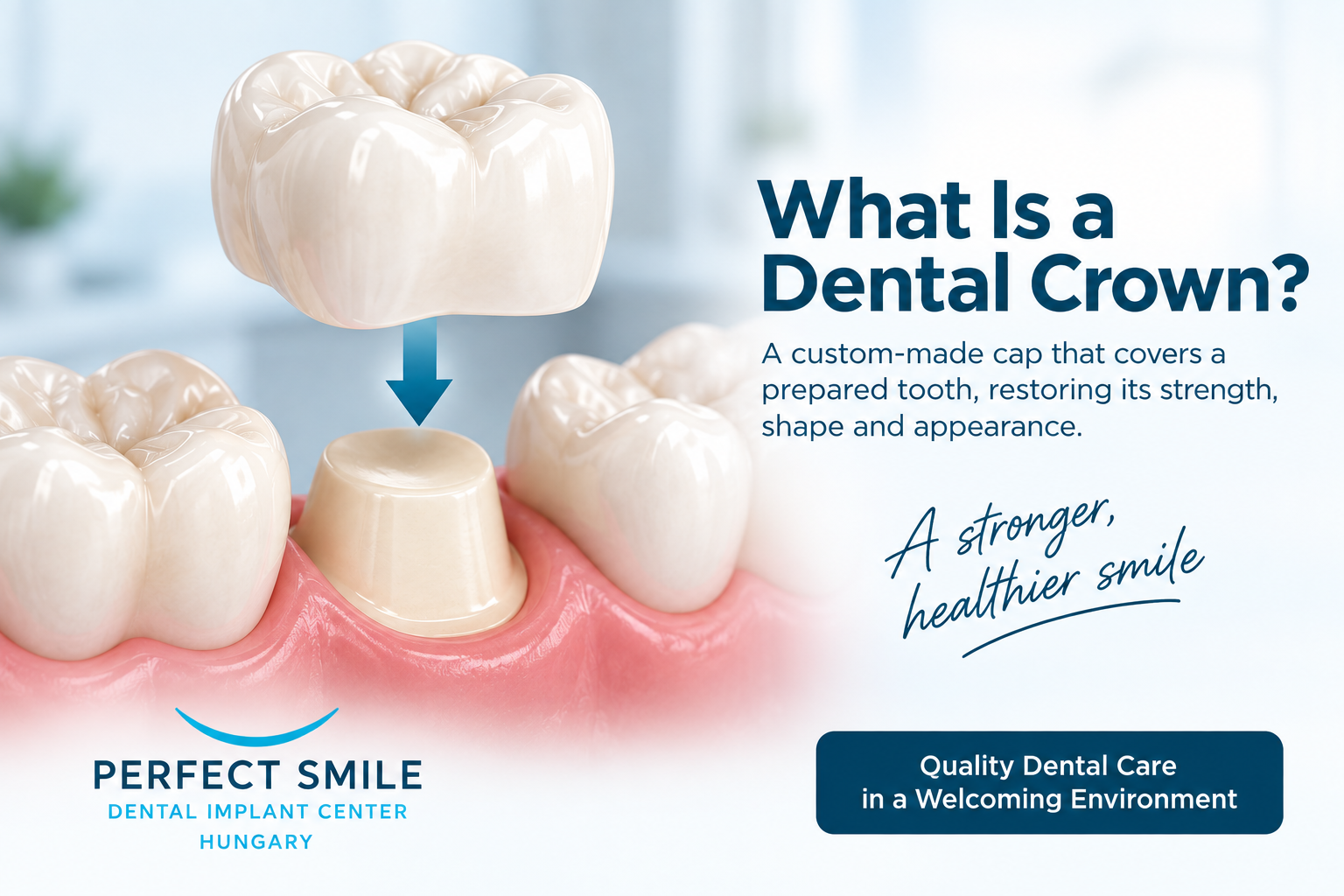
A dental crown, sometimes called a dental cap, is a custom-made restoration that covers a prepared natural tooth. It can restore the shape, strength, appearance and function of a tooth that has been badly damaged, weakened, worn or decayed.
Crowns can also form part of a dental bridge or be attached to a dental implant when a missing tooth is being replaced.
Quick answer:
A dental crown is a tooth-shaped cap fitted over a prepared tooth. It may be recommended when there is not enough healthy tooth remaining for a conventional filling, when a tooth has fractured or weakened, or following certain root canal treatments.
At Perfect Smile Dental Implant Center Hungary, current 2026 prices include a porcelain/PFM crown at €265 and a zirconia crown at €365.
What Does a Dental Crown Do?
The purpose of a crown is to surround the visible portion of a tooth with a strong restoration.
A crown may be used to:
- Restore a badly broken tooth
- Protect a weak or heavily filled tooth
- Restore a tooth with substantial decay once the decay has been treated
- Restore a severely worn tooth
- Cover certain root canal-treated teeth
- Improve the shape or appearance of a tooth where clinically appropriate
- Support part of a dental bridge
- Provide the visible tooth portion of a dental implant restoration
Whether a crown is appropriate depends on how much healthy tooth remains, the condition of the tooth and gums, the patient’s bite and the reason the restoration is required.
Who Might Need a Dental Crown?
A dentist may recommend a crown when a tooth has lost a significant amount of its natural structure but can still be predictably restored.
Common situations include a tooth that has:
- A large filling
- A substantial fracture
- Extensive decay
- Severe wear
- Been weakened following previous treatment
- Undergone root canal treatment and requires additional protection
A crown is not automatically the correct treatment for every damaged tooth. Sometimes a filling, inlay, onlay or another restoration may preserve more natural tooth structure.
What Are Dental Crowns Made From?
Dental crowns can be manufactured from several restorative materials.
Porcelain / PFM Crowns
A porcelain-fused-to-metal crown has a metal framework covered by tooth-coloured porcelain.
PFM crowns have been used successfully in restorative dentistry for many years.
Zirconia Crowns
Zirconia is a strong dental ceramic made from zirconium dioxide. Modern zirconia can combine considerable strength with increasingly natural-looking aesthetics.
All-Ceramic Crowns
Different ceramic materials may be used where appearance is particularly important. The most appropriate material depends on the tooth and clinical circumstances.
Metal Crowns
Metal alloys have also traditionally been used for dental crowns because of their strength, particularly on less visible teeth.
If you’re deciding between the two options offered most commonly at Perfect Smile, see our detailed comparison of zirconia vs porcelain crowns.
How Much Does a Dental Crown Cost in Hungary?
The current Perfect Smile Dental Implant Center Hungary 2026 crown prices include:
Porcelain / PFM Crown
€265Current price per crown.
Zirconia Crown
€365Current price per crown.
Other relevant current prices include:
- Temporary acrylic crown – €20
- Long-term temporary crown – €80
- Root canal treatment – €80
These are individual treatment prices. The total cost depends on what treatment the tooth requires before the crown can be fitted.
For the wider comparison of crown options and prices, see Types of Dental Crowns and the Cost 2026.
What Happens During a Dental Crown Procedure?
The exact procedure varies according to the condition of the tooth and the type of restoration being made, but a laboratory-made crown commonly involves several stages.
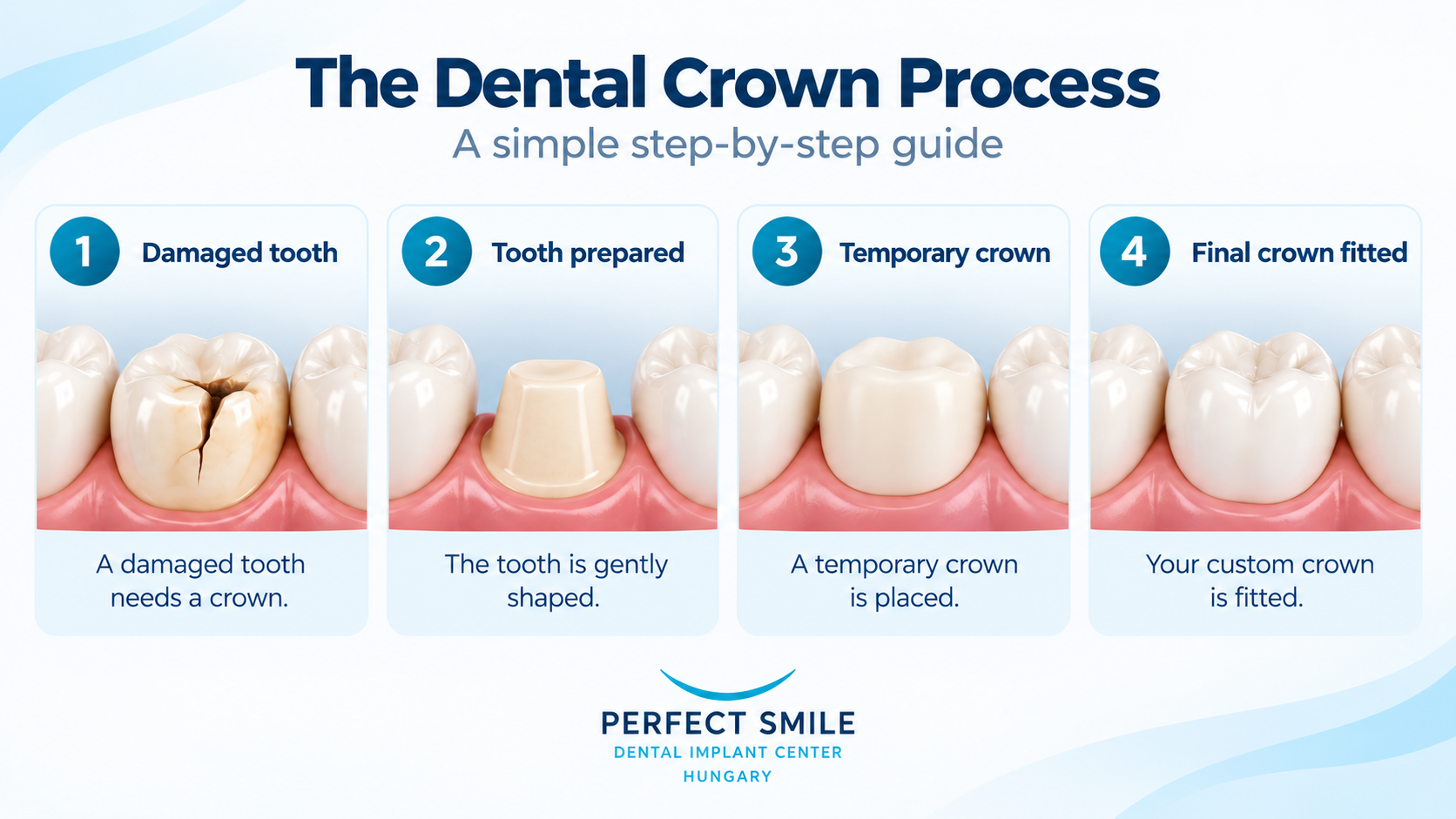
The dentist examines the tooth and determines whether a crown is appropriate. Dental X-rays or other imaging may be required.
Any decay or other dental problems affecting the tooth need to be addressed before the definitive crown is fitted.
A controlled amount of tooth structure is removed to create sufficient space and the correct shape for the crown.
An impression or digital scan records the prepared tooth and surrounding teeth so the crown can be made to fit accurately.
Where required, a temporary crown protects the prepared tooth while the definitive crown is being manufactured.
The dentist checks the shape, contact, bite, shade and fit before the definitive crown is secured in place.
Important: No dental treatment is carried out in Wexford. Dental crown treatment is performed at Perfect Smile Dental Implant Center Hungary.
Do You Always Need a Temporary Crown?
A temporary crown is often used when a laboratory is manufacturing the definitive restoration.
Its purpose is to protect the prepared tooth, help maintain appearance and function, and reduce unwanted movement of neighbouring teeth while the final crown is being made.
The exact treatment sequence depends on the individual case.
Does Getting a Crown Hurt?
The tooth is normally prepared using local anaesthetic where appropriate.
Some temporary sensitivity or tenderness can occur after crown preparation or fitting. Persistent pain, swelling or a bite that feels significantly wrong should be assessed by a dentist.
How Much Natural Tooth Is Needed for a Crown?
A crown needs an adequate foundation and sufficient support to remain securely retained.
If much of the natural tooth has been lost through decay, fracture or previous treatment, the dentist may need to rebuild the tooth before fitting a crown.
The important question is not simply how many millimetres of tooth remain. The dentist needs to assess the amount and quality of healthy tooth structure, the position of the remaining tooth, the root, the gum and bone support, and the forces placed on it during biting.
In some cases a tooth can be successfully rebuilt. In others, too much damage may have occurred for a crown to provide a predictable long-term restoration.
What Is a Core Build-Up?
If a tooth has lost a substantial amount of structure, restorative material may be used to rebuild the missing portion and provide a suitable foundation for the crown.
This is commonly called a core build-up.
Composite resin is one material that may be used for this purpose, although the most appropriate technique depends on the individual tooth.
What Is a Post and Core?
A post and core may sometimes be considered for a root canal-treated tooth when insufficient coronal tooth structure remains to retain the restoration.
The post is placed within the prepared root canal space and helps retain the core material on which the crown is subsequently fitted.
Importantly, a post does not make every weakened tooth suitable for a crown, nor is a post required after every root canal treatment. The dentist determines whether it is appropriate after assessing the remaining tooth structure.
Dental Crowns After Root Canal Treatment
Some teeth become significantly weakened because of the decay, fracture or previous restoration that led to root canal treatment.
A crown may therefore be recommended afterwards to protect and restore the remaining tooth, particularly for teeth subjected to heavy chewing forces.
The current Perfect Smile price for root canal treatment is €80.
You can read the full cost explanation in our guide to root canal and crown cost.
Can a Dental Crown Replace a Missing Tooth?
A crown fitted over a natural tooth cannot replace a tooth that is completely missing.
However, crowns are used as part of several treatments for missing teeth.
Implant-Supported Crown
A dental implant is placed surgically into the jawbone to act as an artificial tooth root. After the required healing and restorative stages, an abutment connects the implant to the final crown.
The crown is therefore the visible replacement tooth, while the implant provides support within the jawbone.
Dental Bridge
A dental bridge can replace one or more missing teeth by supporting a false tooth or teeth from suitable neighbouring teeth or, in some designs, dental implants.
A dentist needs to assess the supporting teeth before recommending a conventional bridge.
What Are the Benefits of a Dental Crown?
A dental crown can provide several benefits when it is the appropriate treatment for the tooth.
- Protect weakened tooth structure
- Restore normal biting and chewing function
- Rebuild the shape of a broken or badly worn tooth
- Improve appearance where appropriate
- Support teeth that have lost substantial natural structure
- Form part of implant or bridge treatment
The main objective is not simply to make the tooth look better. A successful crown should provide an appropriate balance of strength, function, fit and appearance.
How Long Do Dental Crowns Last?
There is no guaranteed lifespan for a dental crown.
Many crowns remain functional for years, but longevity varies according to:
- The condition of the supporting tooth
- Oral hygiene
- Gum health
- The crown material
- The quality of the fit
- Biting and chewing forces
- Grinding or clenching
- Diet and habits
- Regular dental care
If a crown becomes loose, chipped, uncomfortable or develops a gap around the edge, it should be checked by a dentist.
Can a Tooth Decay Under a Crown?
Yes.
The crown material itself cannot develop tooth decay, but the natural tooth underneath and around the crown margin can still decay.
This is why good oral hygiene remains essential even when a tooth is covered by a crown.
How Do You Look After a Dental Crown?
A crowned tooth should generally be cared for much like your natural teeth.
- Brush thoroughly at least twice daily with fluoride toothpaste
- Clean between your teeth regularly
- Pay particular attention to the crown margin near the gum
- Attend recommended dental examinations
- Avoid repeatedly biting extremely hard objects
- Discuss a night guard with your dentist if you grind or clench your teeth
What Can Go Wrong With a Dental Crown?
Dental crowns are designed to be durable, but problems can occasionally occur.
These may include:
- A loose crown
- Chipping or fracture
- Decay around the crown margin
- Gum problems
- Sensitivity
- Problems with the underlying tooth
- A crown that feels too high when biting
If a crown comes loose or falls out, keep it and contact a dentist rather than trying to permanently glue it back yourself.
We have a separate guide explaining why dental crowns fall out.
What Are the Alternatives to a Dental Crown?
The best alternative depends on why treatment is required.
Filling or Bonding
Smaller areas of damage or decay may sometimes be restored without covering the entire tooth.
Inlay or Onlay
An inlay or onlay may be considered where a tooth needs more support than a filling but does not necessarily require a full crown.
Dental Veneer
Where the concern is mainly cosmetic and sufficient healthy tooth remains, a veneer may sometimes be considered instead of a crown.
Extraction and Tooth Replacement
If a tooth cannot be predictably restored, extraction followed by a bridge, implant or removable restoration may be considered.
Dental Crown Treatment in Hungary
Patients arranging treatment through Hungarian Dentists Wexford receive their dental treatment at Perfect Smile Dental Implant Center Hungary.
A small team from Perfect Smile travels to Wexford approximately every four weeks for scheduled consultations, reviews and appropriate follow-up and aftercare.
A free consultation and panoramic X-ray can be arranged during these scheduled visits.
No dental treatments are carried out in Wexford. Treatment itself takes place at Perfect Smile Dental Implant Center Hungary.
Considering Several Dental Crowns?
Travelling abroad may not make financial sense simply to save money on one crown once flights, accommodation and other travel expenses are considered.
It may become more worthwhile to investigate when several crowns or more extensive dental treatment are required.
The important comparison is the complete treatment plan and complete travel cost, rather than the price of an individual crown alone.
Do You Think You May Need a Dental Crown?
You can arrange a free consultation and panoramic X-ray in Wexford during a scheduled Perfect Smile visit before deciding whether treatment in Hungary is suitable for you.
Call Fintan: 087 349 0104 Free ConsultationFrequently Asked Questions
What is a dental crown?
A dental crown is a custom-made cap that covers a prepared natural tooth to restore its shape, strength, appearance or function.
Is a crown the same thing as a cap?
Yes. Dental crown and dental cap are two commonly used terms for the same type of restoration.
Does the dentist remove the whole tooth for a crown?
No. When crowning a natural tooth, the dentist reshapes the existing tooth to create sufficient space and support for the restoration. How much preparation is required depends on the tooth and crown design.
How much is a porcelain crown in Hungary?
The current 2026 Perfect Smile Dental Implant Center Hungary price for a porcelain/PFM crown is €265.
How much is a zirconia crown in Hungary?
The current 2026 Perfect Smile price for a zirconia crown is €365.
Does every root canal-treated tooth need a crown?
Not necessarily. The dentist assesses factors such as the position of the tooth, amount of remaining tooth structure and biting forces before deciding which restoration is appropriate.
Can decay develop underneath a crown?
Yes. The crown material does not decay, but the underlying natural tooth can develop decay, particularly around the crown margin.
Can a crown be fitted to a dental implant?
Yes. An implant-supported crown is a replacement tooth attached to a dental implant, normally through an abutment. This differs from a conventional crown fitted over a natural tooth.
Is dental crown treatment carried out in Wexford?
No. Wexford provides scheduled consultations, reviews and appropriate follow-up support. Dental treatment is carried out at Perfect Smile Dental Implant Center Hungary.
What Is a Dental Crown? The Bottom Line
A dental crown is one of the main ways dentists can restore and protect a badly damaged or weakened tooth while preserving the natural tooth where possible.
But a crown is not automatically the correct solution for every damaged tooth. The dentist first needs to determine whether the tooth can be predictably restored and which crown material or alternative treatment is most suitable.
For patients considering treatment at Perfect Smile Dental Implant Center Hungary, current 2026 prices are €265 for a porcelain/PFM crown and €365 for a zirconia crown.
To compare the materials in greater detail, read our guide to Zirconia vs Porcelain Crowns.
Related Dental Crown Guides
Independent Information About Dental Crowns
For independent patient information about crowns and common dental treatments, see NHS dental treatment information .
Medical information notice: This article provides general information about dental crowns. It does not replace an examination, diagnosis or individual treatment recommendation from a qualified dentist. The appropriate restoration depends on the condition of the individual tooth and the patient’s clinical circumstances.