Updated September 2026 | Hungarian Dentists Wexford
Choosing between zirconia vs porcelain crowns can be confusing because both can produce attractive, natural-looking replacement teeth, but they are not exactly the same.
The right crown depends on much more than appearance. Your dentist may consider the position of the tooth, the strength of your bite, how much natural tooth remains, the colour of neighbouring teeth and whether the crown will be visible when you smile.
There is also an important distinction that is often missed online: zirconia is not a metal infused with ceramic. Zirconia, or zirconium dioxide, is a dental ceramic.
Quick answer: zirconia or porcelain?
Zirconia crowns are particularly well known for their strength and durability and are widely used for both front and back teeth depending on the type of zirconia selected.
Porcelain-based crowns can provide excellent aesthetics. Porcelain may be used as part of an all-ceramic restoration or layered over a metal framework, known as a porcelain-fused-to-metal or PFM crown.
At Perfect Smile Dental Implant Center Hungary, the current 2026 price is €265 for a porcelain/PFM crown and €365 for a zirconia crown.
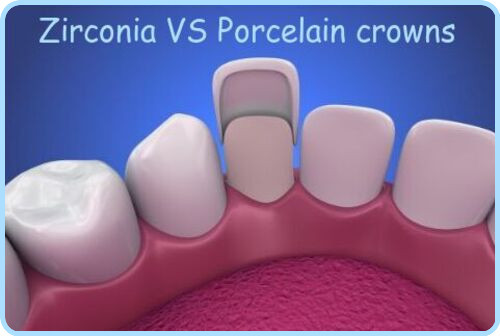
What Is a Zirconia Crown?
A zirconia crown is made primarily from zirconium dioxide, a strong ceramic material used in modern restorative dentistry.
Zirconia crowns are normally designed digitally and manufactured using CAD/CAM technology.
Different types of zirconia are available. Some place greater emphasis on strength, while newer, more translucent forms have been developed to improve appearance.
This means it is no longer accurate to say that zirconia is suitable only for back teeth. Depending on the individual case and the zirconia material selected, it may also be used for visible front teeth.
What Is a Porcelain Crown?
The expression porcelain crown can describe more than one type of restoration, which is one reason online comparisons can become confusing.
A porcelain crown may be an all-ceramic restoration, or porcelain can be bonded over a metal framework. The latter is normally called a porcelain-fused-to-metal crown, or PFM crown.
PFM crowns have been used in dentistry for many years. The metal framework provides support while the porcelain covering is shaped and coloured to resemble a natural tooth.
At Perfect Smile Dental Implant Center Hungary, the current price list includes a porcelain/PFM crown at €265.
Zirconia vs Porcelain Crowns: Main Differences
Zirconia Crown
- Made from zirconium dioxide ceramic
- Very strong dental restorative material
- No traditional metal coping
- Available in different levels of translucency
- Frequently manufactured using CAD/CAM technology
- Can be considered for front or back teeth depending on the case
- Current Perfect Smile price: €365
Porcelain / PFM Crown
- Porcelain layered over a metal framework
- Long-established crown option
- Can provide a natural tooth-coloured appearance
- Strong underlying metal structure
- Porcelain layer can chip in some circumstances
- May be suitable for front or back teeth depending on the case
- Current Perfect Smile price: €265
Which Looks Better: Zirconia or Porcelain?
There is no universal winner.
Traditional porcelain has long been valued in dentistry because dental technicians can reproduce subtle variations in colour and translucency.
Older zirconia materials were generally more opaque. Modern zirconia materials have become considerably more aesthetically versatile, and highly translucent zirconia can now be considered in situations where appearance is particularly important.
The final result depends on more than the crown material itself. Important factors include:
- The shade selected
- The colour of the underlying tooth
- The thickness of the restoration
- The position of the tooth
- The skill of the dentist and dental laboratory
- The appearance of the neighbouring natural teeth
For a highly visible front tooth, the dentist and dental technician should consider the entire smile rather than simply choosing whichever material sounds more attractive on paper.
Which Is Stronger: Zirconia or Porcelain?
Zirconia is particularly well known for its mechanical strength.
This is one reason zirconia has become widely used for crowns in areas where considerable biting forces may be present.
That does not mean a porcelain/PFM crown is weak. PFM crowns have a strong metal substructure and have a long history of clinical use.
One potential difference is that the outer porcelain layer of a PFM crown can sometimes chip or fracture. Zirconia restorations can also experience complications, so no crown should be regarded as indestructible.
Important: Choosing a crown solely because one material is described as “stronger” is not necessarily the right approach. The condition of the tooth, bite, crown design and clinical situation are also important.
Zirconia vs Porcelain Crowns for Front Teeth
Front teeth place a particularly high emphasis on appearance because they are visible when speaking and smiling.
Porcelain-based restorations have traditionally been popular for front teeth because of their aesthetic qualities.
However, modern translucent zirconia has expanded the situations in which zirconia can be considered for anterior teeth.
Your dentist may consider factors such as:
- How much light needs to pass through the restoration
- The colour of the natural tooth beneath it
- Whether neighbouring teeth already have crowns
- Your bite
- How much strength is required
- The shade and character of your natural teeth
Zirconia vs Porcelain Crowns for Back Teeth
Back teeth generally experience greater chewing forces than front teeth, so strength becomes an important consideration.
Zirconia is frequently considered for posterior crowns because of its mechanical properties.
PFM crowns may also be used on back teeth and have been used successfully for many years.
Again, there is no rule stating that every back tooth should receive zirconia or every front tooth should receive porcelain. Treatment should be selected for the individual tooth and patient.
Advantages of Zirconia Crowns
- Strength: Zirconia has excellent mechanical properties and can withstand significant biting forces.
- Appearance: Modern zirconia is available in increasingly translucent and natural-looking forms.
- No metal coping: A zirconia crown does not require the traditional metal substructure found in a PFM crown.
- Digital manufacturing: Zirconia restorations are commonly produced using precise CAD/CAM systems.
- Versatility: Different zirconia materials can be selected according to the balance of strength and aesthetics required.
Possible Disadvantages of Zirconia Crowns
- Cost: At Perfect Smile, zirconia currently costs more than a PFM crown.
- Adjustment: Zirconia is a very hard material, so careful finishing and polishing are important if adjustments are required.
- Aesthetic differences: Some highly strong zirconia materials may be more opaque than glassier ceramic materials.
- No crown is fracture-proof: Zirconia is strong, but complications can still occur.
Advantages of Porcelain / PFM Crowns
- Natural appearance: Porcelain can be shaped and shaded to resemble natural teeth.
- Long history: PFM crowns have been used successfully in restorative dentistry for many years.
- Strong support: The underlying metal framework provides structural support.
- Lower current Perfect Smile price: A porcelain/PFM crown is currently €265 compared with €365 for zirconia.
Possible Disadvantages of Porcelain / PFM Crowns
- The porcelain outer layer may chip in some circumstances.
- A PFM crown contains a metal substructure, which some patients would prefer to avoid.
- In some cases a darker metal margin may become visible near the gum line, particularly if the gum recedes.
- Appearance depends greatly on crown design, shade selection and laboratory work.
Zirconia vs Porcelain Crown Cost in Hungary 2026
The current Perfect Smile Dental Implant Center Hungary prices are:
Porcelain / PFM Crown
€265Current 2026 price per crown.
Zirconia Crown
€365Current 2026 price per crown.
The difference between the two current crown prices is €100 per tooth.
That price difference can become more significant when several crowns are required, but cost should not be the only reason for choosing one material over another.
Other crown-related prices on the current Perfect Smile price list include:
- Temporary acrylic crown – €20
- Long-term temporary crown – €80
See our complete guide to types of dental crowns and their cost for more information.
What About the Cost of Crowns in Ireland?
Crown prices vary between Irish dental practices according to the material used, the dentist, laboratory fees and the treatment required before the crown can be fitted.
Rather than using an old national price range that may no longer accurately represent what clinics charge, we recommend obtaining an individual quotation and checking exactly which crown material is included.
If comparing an Irish quote with treatment in Hungary, make sure you are comparing the same type of crown.
A quote for a PFM crown should not automatically be compared with the price of a premium zirconia crown as if the restorations were identical.
Is It Worth Travelling to Hungary for One Dental Crown?
Probably not in every situation.
Flights, accommodation and other travel costs can outweigh the difference in the price of a single crown.
Dental treatment in Hungary tends to make more financial sense to investigate when a patient requires a larger amount of restorative treatment, such as several crowns, dental implants or more extensive rehabilitation.
The total treatment plan and total travel costs should always be considered together.
Do Crowns Last Forever?
No dental crown can be guaranteed to last forever.
Both zirconia and porcelain-based crowns can remain functional for many years, but their longevity depends on factors including:
- Oral hygiene
- Condition of the supporting tooth
- Gum health
- Bite forces
- Grinding or clenching
- Crown fit
- Diet
- Regular dental checks
A crown can also remain intact while the natural tooth beneath it develops a problem, which is why continued dental care remains important.
Can a Crown Be Needed After Root Canal Treatment?
Sometimes.
A tooth that has undergone root canal treatment can be significantly weakened depending on how much natural tooth structure has been lost.
A dentist may recommend a crown or another restoration to protect the remaining tooth, particularly where the tooth is subjected to substantial chewing forces.
At Perfect Smile, the current price for root canal treatment is €80. A PFM crown is €265 and a zirconia crown is €365.
Read our separate guide to root canal and crown cost.
Which Crown Should I Choose?
A Simple Way to Think About the Decision
Zirconia may be worth discussing if:
- You want a very strong ceramic restoration
- You would prefer not to have a traditional metal coping
- The crown will be subjected to substantial biting forces
- Your dentist believes modern zirconia will provide the required appearance
A porcelain/PFM crown may be worth discussing if:
- You want a long-established crown option
- Your dentist believes it provides the right combination of strength and appearance for the tooth
- Having a metal framework is not a concern
- Cost is an important part of the treatment decision
The dentist should make the final recommendation after examining the tooth.
Dental Crown Treatment in Hungary
Patients arranging treatment through Hungarian Dentists Wexford receive their dental treatment at Perfect Smile Dental Implant Center Hungary.

A small team from Perfect Smile visits Wexford approximately every four weeks for scheduled consultations, reviews and appropriate follow-up and aftercare.
A free consultation and panoramic X-ray can be arranged in Wexford before you decide whether treatment in Hungary is appropriate for you.
No dental treatment is carried out in Wexford. Dental treatment takes place at Perfect Smile Dental Implant Center Hungary.
Not Sure Which Dental Crown You Need?
Talk to Fintan about arranging a free consultation in Wexford and finding out what treatment the dental team recommends.
Call Fintan: 087 349 0104 Free ConsultationFrequently Asked Questions About Zirconia vs Porcelain Crowns
Is zirconia a type of metal crown?
No. Dental zirconia is zirconium dioxide, a ceramic material. A zirconia crown does not use the traditional metal coping found inside a porcelain-fused-to-metal crown.
Which is stronger, zirconia or porcelain?
Zirconia is particularly well known for its strength and mechanical properties. However, PFM crowns also have a strong metal framework and a long history of clinical use. The most appropriate material depends on the individual tooth and treatment requirements.
Which looks better on front teeth?
Both can provide attractive results. The best choice depends on the crown material, shade, underlying tooth colour and neighbouring teeth. Modern translucent zirconia has considerably expanded the aesthetic options available for front teeth.
How much is a zirconia crown in Hungary?
The current 2026 Perfect Smile Dental Implant Center Hungary price for a zirconia crown is €365.
How much is a porcelain crown in Hungary?
The current 2026 Perfect Smile price for a porcelain/PFM crown is €265.
Why does zirconia cost more?
Different crown materials and manufacturing processes have different laboratory and production costs. At Perfect Smile, the current price difference between a zirconia crown and a PFM crown is €100.
Can zirconia crowns be used on front teeth?
Yes, zirconia may be used for front teeth in appropriate cases. Modern zirconia is available in more translucent forms than earlier generations, although the dentist should select the material according to the clinical and aesthetic requirements.
Can zirconia crowns be used on back teeth?
Yes. Zirconia is commonly considered for posterior teeth because strength can be particularly important where chewing forces are greater.
Is dental crown treatment carried out in Wexford?
No. Wexford provides scheduled consultations, reviews and appropriate aftercare support. Dental treatment itself takes place at Perfect Smile Dental Implant Center Hungary.
Zirconia vs Porcelain Crowns: The Bottom Line
There is no single crown material that is automatically best for every patient.
Zirconia offers excellent strength and increasingly good aesthetics, while porcelain/PFM crowns remain a proven and lower-priced option at Perfect Smile.
The most important question is not simply “Which crown is best?” but rather which crown is most suitable for this particular tooth?
That decision should take into account appearance, bite, position of the tooth, remaining tooth structure, cost and the dentist’s clinical recommendation.
For a broader explanation of all the available options, visit our guide to Types of Dental Crowns and the Cost 2026.
Related Dental Crown Guides
Independent Dental Research
For readers who want more technical information, a 2024 review in the British Dental Journal discusses developments, properties and clinical considerations relating to zirconia ceramic crowns.
Read the zirconia ceramic crown review on PubMed Central
Medical information notice: This article provides general information about dental crowns and does not replace examination, diagnosis or individual treatment advice from a qualified dentist. Crown selection depends on the condition of the tooth and the patient’s individual clinical requirements.