What Is a Dental Bridge? Cost, Types & Treatment 2026
Updated September 2026 | Hungarian Dentists Wexford
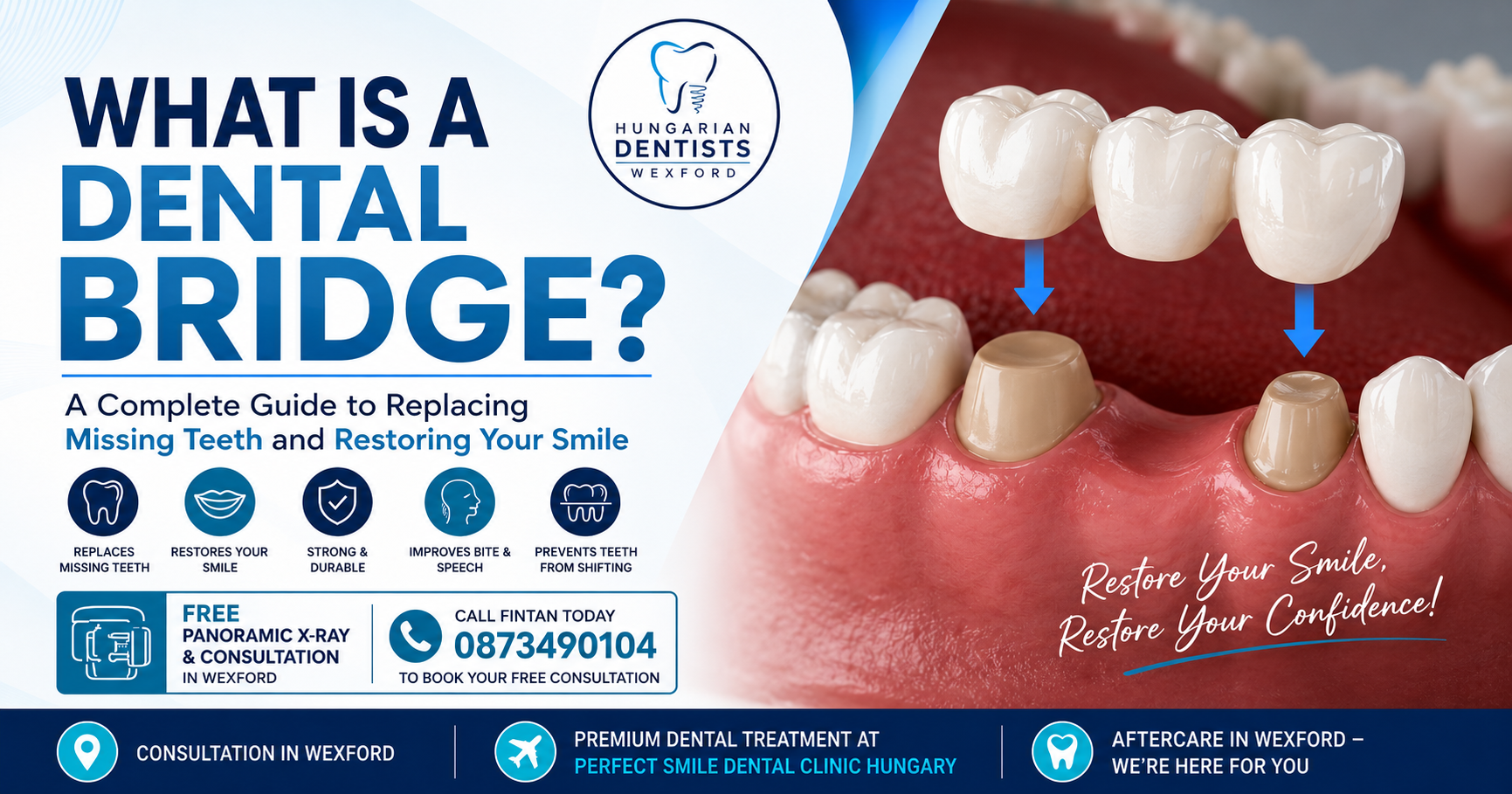
A dental bridge is a fixed replacement for one or more missing teeth. It fills the space left by the missing tooth or teeth and can be supported by natural teeth, dental implants or, depending on the design, bonded to neighbouring teeth.
For people researching dental bridge cost in Ireland, it is important to understand that a bridge is usually made up of several individual units. The final price therefore depends on the number of teeth being replaced, the supporting teeth or implants and the material selected.
At Hungarian Dentists Wexford, patients can begin with a free panoramic X-ray and consultation before deciding whether treatment with Perfect Smile Dental Implant Center Hungary is right for them.
Quick answer:
A dental bridge is a fixed dental restoration used to replace missing teeth.
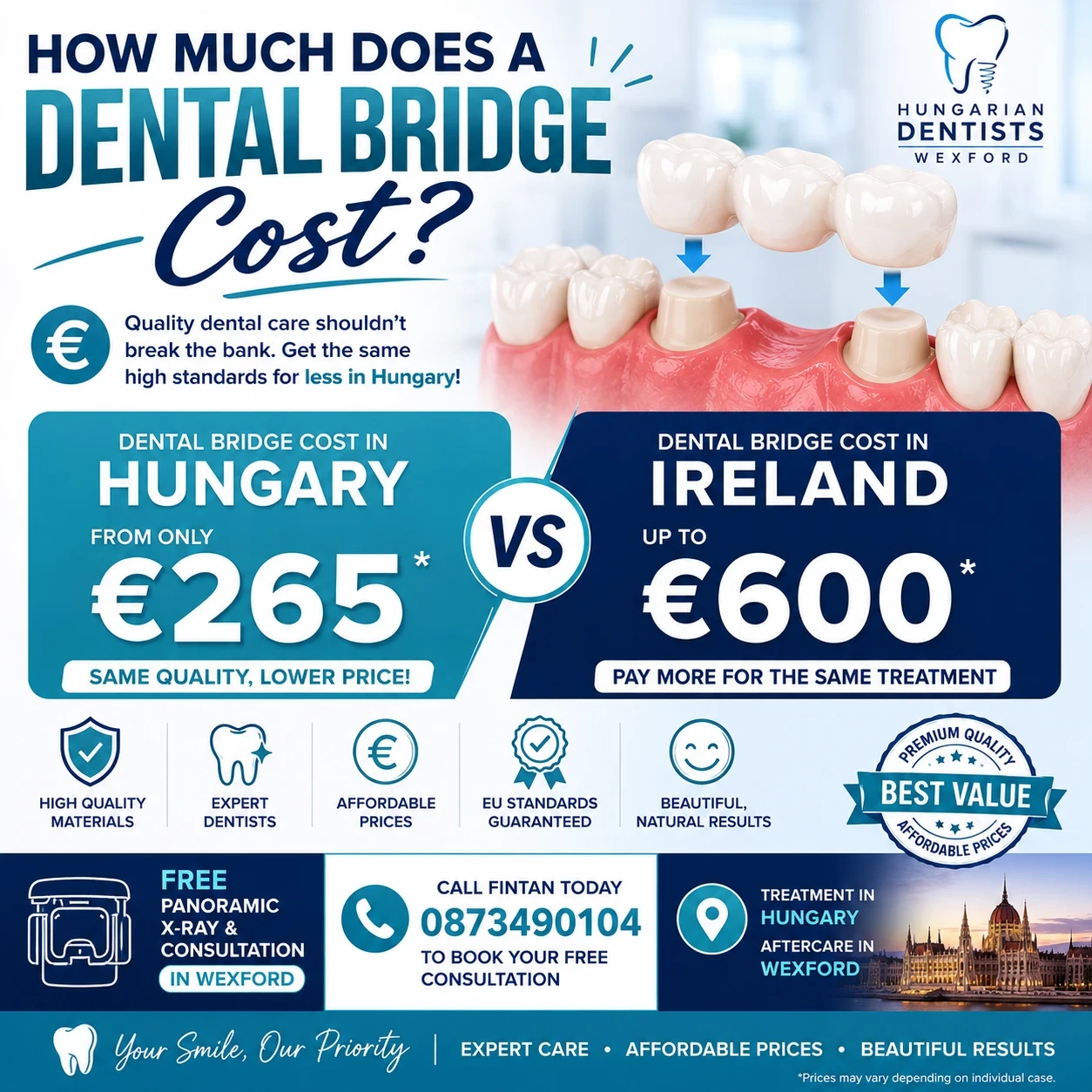
The current Perfect Smile 2026 price list includes a porcelain or porcelain-fused-to-metal crown at €265, a zirconia crown at €365, and a screw-retained bridge/crown component at €265.
€265 should not be interpreted as the total price of every dental bridge. A complete bridge can contain several units and may require supporting crowns, implants or other treatment.
What Is a Dental Bridge?
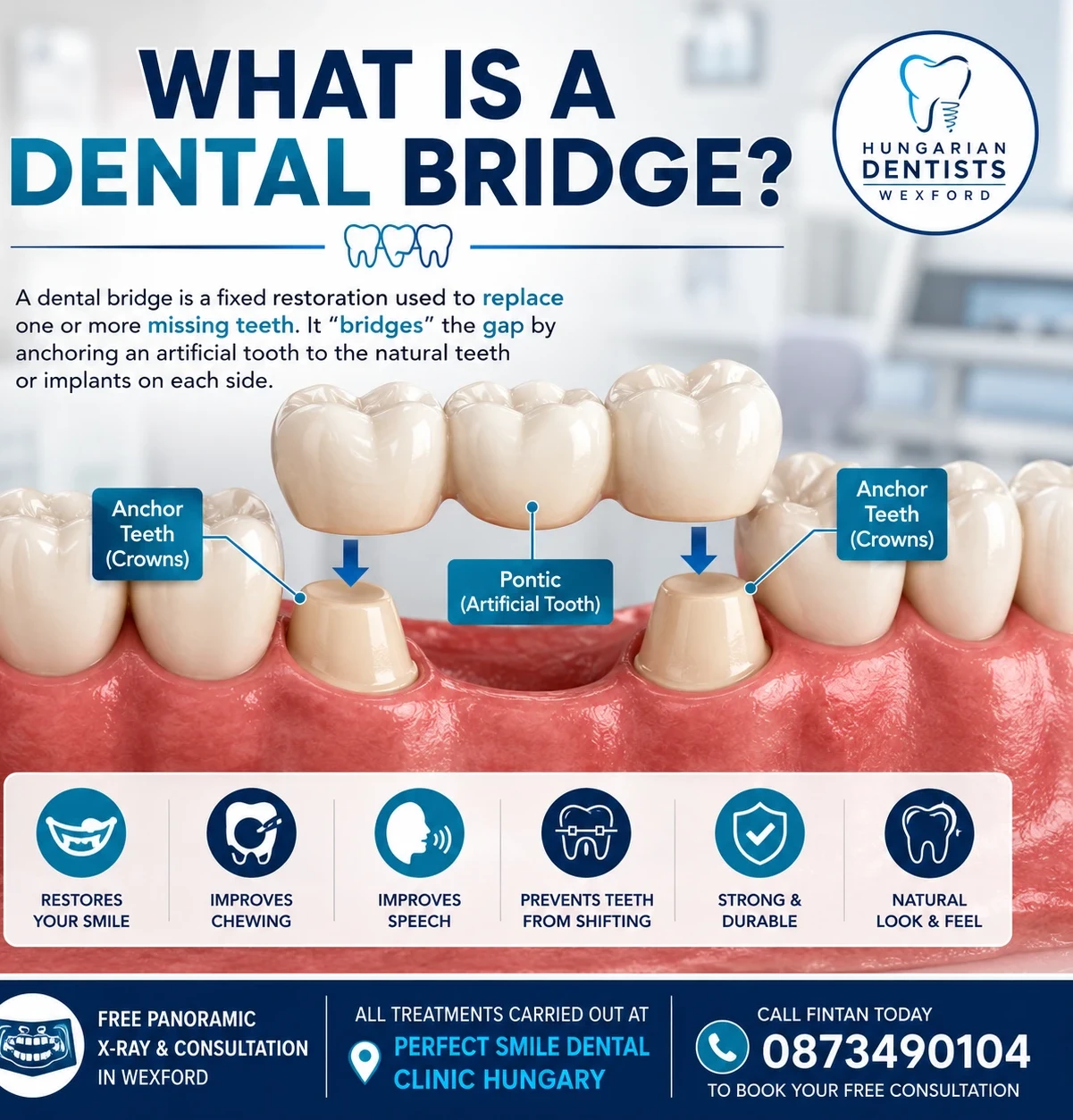
A dental bridge is a fixed dental restoration designed to replace one or more missing teeth.
The artificial replacement tooth is commonly called a pontic. Depending on the bridge design, it may be supported by crowns placed on neighbouring natural teeth, bonded to adjacent teeth or supported by dental implants.
Unlike a removable denture, a conventional fixed bridge is secured in the mouth and is not normally removed by the patient.
Dental bridges can help restore:
- The appearance of missing teeth
- Chewing ability
- Speech where tooth loss has affected pronunciation
- The bite and distribution of chewing forces
- Support for neighbouring teeth
How Does a Dental Bridge Work?
A bridge spans the space created by one or more missing teeth.
With a traditional tooth-supported bridge, the teeth beside the gap are prepared to act as supports. Crowns are fitted over these supporting teeth and connected to the artificial replacement tooth or teeth between them.
With an implant-supported bridge, dental implants rather than natural teeth provide the support.
Different Types of Dental Bridges
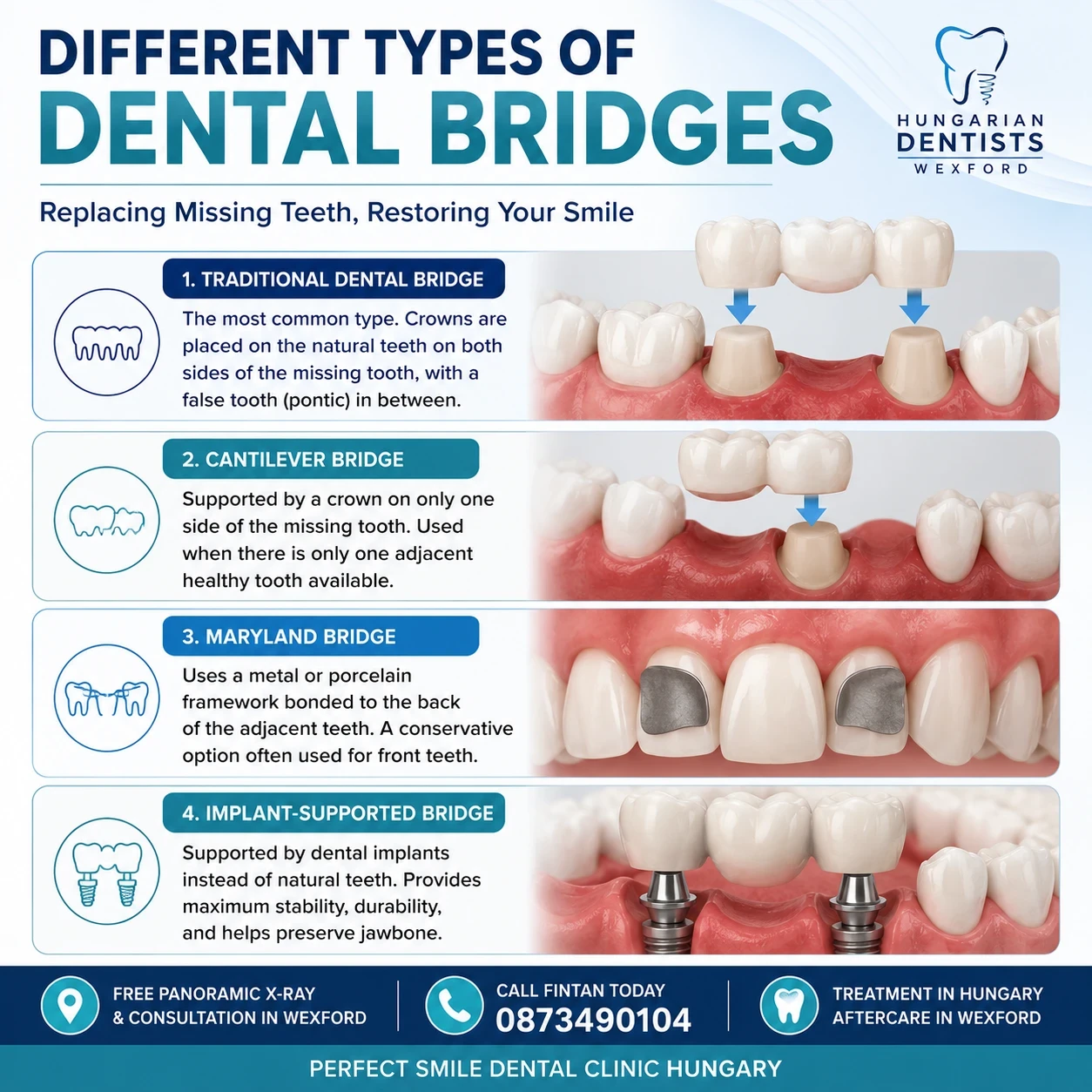
Traditional Dental Bridge
A traditional bridge is normally supported by crowns placed on teeth on either side of the gap.
It may be considered where suitable natural teeth are available to support the restoration.
Cantilever Bridge
A cantilever bridge is supported from one side rather than both sides.
It is only appropriate in selected situations because the forces placed on the supporting tooth need to be carefully considered.
Maryland or Resin-Bonded Bridge
A resin-bonded bridge uses wings bonded to the back of neighbouring teeth rather than full crowns.
It can be an option for selected missing front teeth because less preparation of the neighbouring teeth may be required.
Implant-Supported Bridge
An implant-supported bridge uses dental implants to support the replacement teeth instead of relying entirely on neighbouring natural teeth.
This can be particularly useful when several adjacent teeth are missing.
What Are the Benefits of a Dental Bridge?
Depending on the individual case, a dental bridge can provide several benefits:
- Replace one or more missing teeth
- Restore the appearance of the smile
- Improve chewing ability
- Provide a fixed alternative to a removable denture
- Help restore the bite
- Help prevent unwanted movement of nearby teeth
- Improve confidence when speaking and smiling

Who Is Suitable for a Dental Bridge?
Suitability depends on the type of bridge being considered and the condition of the mouth.
Important factors can include:
- The number and position of missing teeth
- The condition of neighbouring teeth
- Gum health
- The patient’s bite
- Available jawbone if implants are being considered
- Oral hygiene
- Whether existing teeth already require crowns
The dentist needs to examine the mouth before recommending a particular type of bridge.
What Is the Dental Bridge Procedure?
1. Consultation and Assessment
The dentist examines your teeth, gums and bite and reviews appropriate dental imaging.
2. Treatment Planning
The dentist determines whether a traditional bridge, implant-supported bridge or another tooth-replacement option is most appropriate.
3. Tooth Preparation
For a conventional tooth-supported bridge, the supporting teeth are prepared where necessary to receive crowns.
This stage is different for resin-bonded and implant-supported bridges.
4. Impressions or Digital Scans
Measurements are taken so the dental laboratory can manufacture the restoration to fit the patient’s mouth and bite.
5. Temporary Restoration
A temporary restoration may be used while the final bridge is being made.
6. Final Bridge
Once completed, the bridge is checked for fit, appearance and bite before final placement.
How Long Does a Dental Bridge Last?
There is no guaranteed lifespan for a dental bridge.
Research on fixed dental bridges shows that many remain functional for around ten years or longer, although longevity varies according to the bridge design, supporting teeth, oral health and other individual factors.
Good oral hygiene and appropriate dental reviews are important because the health of the supporting teeth and gums can affect the long-term success of the bridge.
How Do You Look After a Dental Bridge?
Daily cleaning is particularly important around and underneath a bridge.
Good care can include:
- Brushing twice daily
- Cleaning underneath the bridge
- Using floss threaders or appropriate interdental cleaning aids
- Attending appropriate dental reviews
- Professional cleaning where recommended
- Avoiding habits that could damage the restoration
Your dentist or hygienist can show you the most appropriate cleaning method for your particular bridge.
Dental Bridge vs Dental Implant
A bridge and a dental implant can both replace missing teeth, but they work differently.
| Dental Bridge | Dental Implant |
|---|---|
| Can use neighbouring teeth for support | Uses an implant fixture placed in the jawbone |
| May avoid implant surgery | Does not normally require neighbouring teeth to support the replacement tooth |
| Treatment can sometimes be completed more quickly | Usually requires a healing period after implant placement |
| Can replace one or several teeth | Can support a single crown or several teeth as part of a bridge |
Neither option is automatically better for everyone. The best treatment depends on the condition of the remaining teeth, jawbone, gums, bite and the patient’s preferences.
If implants are being considered, see our complete guide to dental implant costs in Hungary in 2026 .
How Much Does a Dental Bridge Cost?
There is no single dental bridge cost in Ireland because a bridge is not necessarily one dental unit.
The final cost depends on:
- The number of missing teeth
- The number of bridge units required
- The bridge material
- Whether natural teeth or implants provide support
- Whether supporting teeth require additional treatment
- Whether root canal treatment or core build-ups are required
- Whether implant surgery is required
Dental Bridge Prices at Perfect Smile Hungary in 2026
The current Perfect Smile Dental Implant Center Hungary price list includes several treatment components that can be relevant to dental bridge treatment.
| Treatment Component | 2026 Price |
|---|---|
| Porcelain-Fused-to-Metal Crown | €265 |
| Porcelain Crown | €265 |
| Zirconia Crown with CAD Technology | €365 |
| Screw-Retained Bridge / Crown | €265 |
| Implant Abutment for Screw-Retained Bridge / Crown | €130 |
| Premium Dental Implant – Nobel, Straumann or BioHorizons | €795 |
Important price clarification:
The €265 screw-retained bridge/crown price is a listed treatment component. It does not mean that every complete dental bridge costs €265. A bridge may involve several units, supporting crowns, implant abutments or dental implants, depending on the treatment plan.
For all current treatment charges, see our Dental Treatment Price List 2026 .
Dental Bridge Cost Ireland vs Hungary
Dental bridge prices in Ireland vary from clinic to clinic and also depend heavily on the number of units involved.
For that reason, simply comparing an Irish crown price with a €265 Hungarian treatment component can give a misleading impression of the total saving.
A better comparison is to obtain a written treatment plan showing:
- The number of bridge units
- The material being used
- Any supporting crowns required
- Whether root canal treatment is necessary
- Whether implants are required
- Temporary restorations
- The complete proposed treatment cost
The financial difference can become more significant when several crowns or a larger bridge are required, but travel and accommodation also need to be considered.
Traditional Bridge or Implant-Supported Bridge?
A conventional bridge may be appropriate where neighbouring teeth provide suitable support.
An implant-supported bridge may be considered where several teeth are missing or where using natural teeth as supports is not considered the best option.
Implant-supported treatment usually takes longer because implants need time to integrate with the jawbone before the final restoration is completed.
We also have a separate guide specifically about dental implants with a bridge .
Dental Bridges for Front Teeth
Replacing a missing front tooth involves particularly important aesthetic considerations.
Depending on the individual situation, possible options can include a traditional bridge, resin-bonded bridge or implant-supported restoration.
For this specific situation, see our guide to dental bridges for front teeth .
Can You Claim Tax Relief on Dental Bridge Treatment?
Revenue currently lists certain bridgework as qualifying non-routine dental treatment for income tax relief.
Revenue’s Med 2 guidance specifically refers to enamel-retained and tooth-supported bridgework.
Treatment eligibility depends on the actual work carried out and the patient’s tax circumstances, so you should check Revenue’s current rules rather than assume that every bridge-related cost qualifies.
View Revenue’s Med 2 dental treatment guidance .
Why Perfect Smile Dental Implant Center Hungary?
Patients considering treatment through Hungarian Dentists Wexford are treated at Perfect Smile Dental Implant Center Hungary.
The treatment pathway combines treatment planning and dental care in Hungary with a local point of contact in Wexford.
Patients can also read experiences shared on our patient testimonials page .

Free Consultation in Wexford
Hungarian Dentists Wexford offers a free panoramic X-ray and dental consultation for patients considering treatment with Perfect Smile Dental Implant Center Hungary.
A small team from Perfect Smile Dental Implant Center Hungary visits Wexford approximately every four weeks for consultations, reviews and appropriate follow-up and aftercare.
No dental treatment is carried out at Hungarian Dentists Wexford. Dental treatment takes place at Perfect Smile Dental Implant Center Hungary.
The Wexford consultation gives you an opportunity to discuss your missing teeth and possible treatment before deciding whether you want to travel.
Your Treatment Plan
Following your assessment, an individual treatment plan can explain:
- The condition of your teeth
- The proposed bridge or alternative treatment
- The number of units required
- Any additional treatment recommended
- How long treatment is expected to take
- The proposed treatment cost
Considering a Dental Bridge?
Arrange a free panoramic X-ray and dental consultation in Wexford and find out what type of tooth replacement is actually suitable for you.
Call Fintan on 087 349 0104
Call 087 349 0104 Free ConsultationFrequently Asked Questions About Dental Bridges
What is a dental bridge?
A dental bridge is a fixed restoration used to replace one or more missing teeth. It can be supported by neighbouring natural teeth or dental implants, depending on the design.
How much does a dental bridge cost?
There is no single bridge price because the total depends on the number of units, material and type of support required. A treatment plan is needed to establish the complete cost.
Does a dental bridge cost €265 at Perfect Smile Hungary?
Not necessarily. €265 is the current listed price for a porcelain/PFM crown and for a screw-retained bridge/crown component. A complete bridge can contain several units and may require additional treatment.
How long does a dental bridge last?
There is no guaranteed lifespan. Published evidence suggests many fixed bridges remain successful for around ten years or longer, although individual results vary considerably.
Can I eat normally with a dental bridge?
Many people can eat normally with a properly fitted bridge after an initial adjustment period. Your dentist may give specific advice depending on the restoration.
Does every missing tooth need a dental implant?
No. Depending on your mouth, possible replacement options can include a traditional bridge, resin-bonded bridge, implant-supported restoration or removable denture.
Can I have dental bridge treatment in Wexford?
No. Hungarian Dentists Wexford provides consultations, reviews and appropriate aftercare. Dental treatment is carried out at Perfect Smile Dental Implant Center Hungary.
How many trips to Hungary are required?
This depends on the treatment. A conventional tooth-supported bridge may have a different treatment schedule from an implant-supported bridge. Implant treatment normally requires a healing period before the final bridge can be fitted.
What Is a Dental Bridge? The Bottom Line
A dental bridge is one of several ways to replace missing teeth.
The correct bridge and its total cost depend on the number of missing teeth, the condition of the supporting teeth, the material selected and whether dental implants are required.
The current Perfect Smile price list includes porcelain/PFM crowns and screw-retained bridge/crown components at €265, but this should not be confused with the total price of a complete multi-unit bridge.
The most reliable way to compare dental bridge cost in Ireland and Hungary is to obtain a complete written treatment plan showing exactly what treatment and how many units are required.
Related Guides
- Dental Crown Cost Ireland 2026
- Dental Implants Cost in Hungary 2026
- Dental Implants With a Bridge
- Dental Bridges for Front Teeth
- Pros and Cons of Dental Bridges
- Dental Treatment Price List 2026
References
Medical information: This page provides general information about dental bridges, missing-tooth treatment and treatment costs. It is not a diagnosis and does not replace examination or individual advice from a qualified dental professional.