How to Find a Dentist Abroad: A Safer Guide to Affordable Dental Tourism in 2026

Travelling abroad for dental treatment can be tempting when you discover how much treatments such as dental implants, crowns, bridges and extensive restorative dentistry can cost at home.
But for most people, price isn’t the first concern.
It’s trust.
How do you find a dentist abroad that you can genuinely feel comfortable with?
Will the dentist be properly qualified? Will the clinic use good-quality materials? Will you understand the treatment being proposed? Can you trust the patient testimonials you read online? And perhaps most importantly, what happens if you need help after you return home?
These are sensible questions.
The Dental Council of Ireland provides guidance for people choosing a dentist at home or abroad and recommends that patients considering overseas treatment research their options and ask appropriate questions before proceeding.
This guide looks at how to find a dentist abroad, what to look for in dental work abroad testimonials, how to approach affordable dental tourism in 2026, and why dental tourism in Hungary continues to interest people considering extensive dental treatment.
The aim isn’t to convince you that travelling abroad is right for everyone.
It’s to help you ask the right questions so that you can make your own informed decision.
Why Are People Considering Dental Treatment Abroad?
For many people, the journey begins with a treatment plan at home.
They may need several dental implants, multiple crowns, a bridge or more extensive restorative work. When several treatments are required, the total cost can become substantial.
That naturally leads to a question:
Could I have the treatment carried out elsewhere for less?
This is where dental tourism enters the picture.
Patients travel from Ireland, the UK and elsewhere for dental treatment in other countries. Hungary is one European destination that has become associated with dental tourism.
However, comparing prices should only be the beginning of your research.
A lower price doesn’t automatically mean poor dentistry. Equally, an impressive website and an attractive quotation don’t automatically mean you’ve found the right dentist.
The important thing is knowing what to investigate before making your decision.
The Biggest Question: Can You Trust a Dentist Abroad?
There isn’t a simple yes-or-no answer.
There are highly experienced dentists and modern clinics in many countries, just as standards and individual practitioners can vary anywhere.
The better question is:
What evidence do I have that I can trust this particular dentist and clinic?
That’s something you can investigate.
Before agreeing to extensive dental work abroad, find out who will actually perform your treatment, what qualifications and professional registration they hold, what treatment is being proposed and what arrangements exist if complications occur.
For treatment within the EU, patients can also use official European cross-border healthcare information and National Contact Points to learn more about healthcare systems, providers, patients’ rights and relevant quality and safety arrangements.
Check. Ask questions. Understand your treatment. Then make your decision.
How to Find a Dentist Abroad: 8 Things to Check
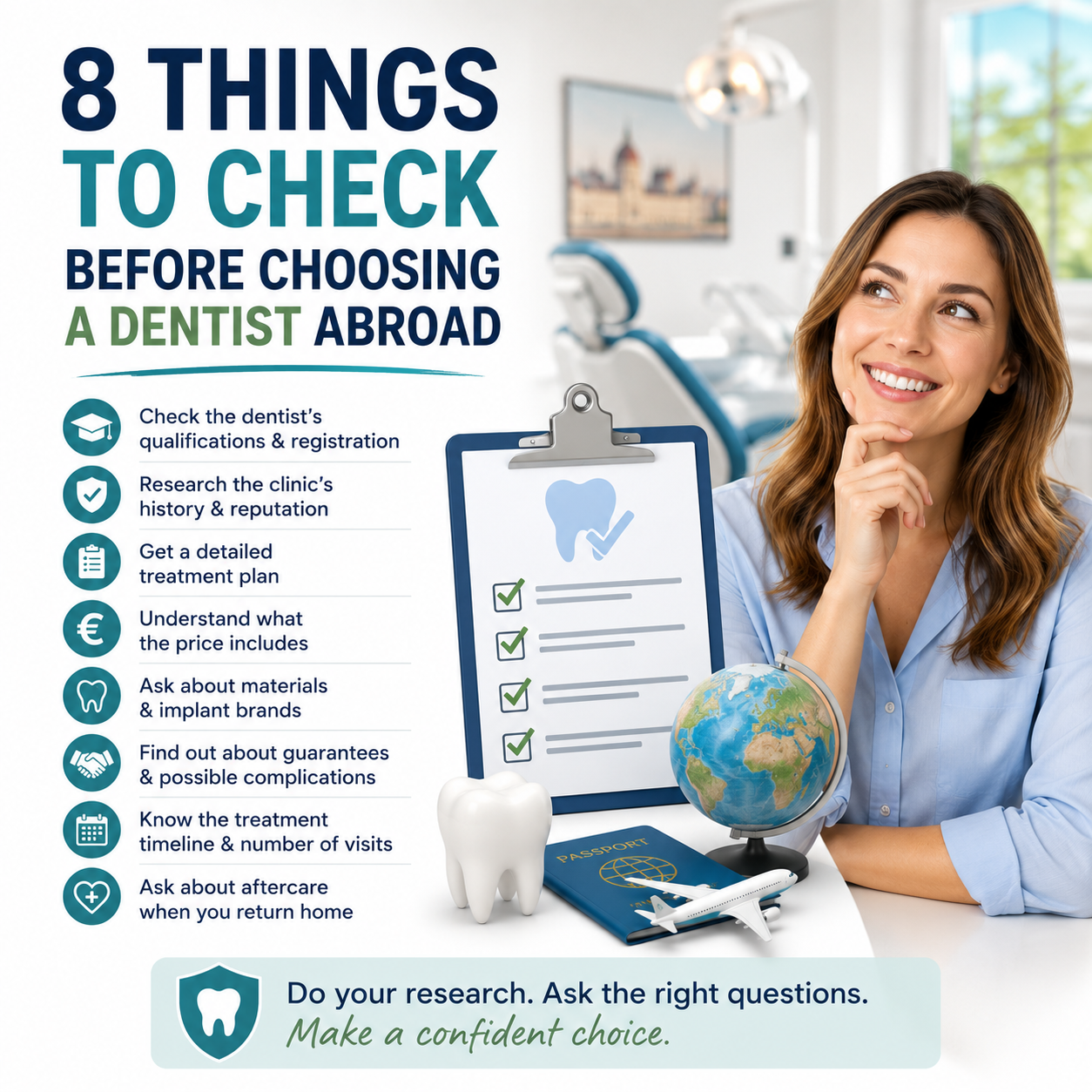
If you’re researching dental treatment overseas, these eight checks can help you compare dentists and clinics more carefully.
1. Find Out Who Will Actually Treat You
Don’t research only the dental clinic.
Research the dentist.
Ask for the full name of the dentist or dental professional expected to perform your treatment.
For more complicated procedures, you may also want to know who will perform individual stages of the treatment.
Ask about:
- Professional qualifications
- Professional registration
- Experience
- Areas of dental practice
- Experience with the particular procedure you require
A reputable clinic should be comfortable answering reasonable questions about the professionals treating you.
2. Check the Clinic’s Credentials
A beautiful clinic is reassuring, but photographs aren’t enough.
Find out how long the clinic has been operating and whether the relevant dentists and healthcare professionals are appropriately registered or authorised under the rules that apply in that country.
Also look beyond the clinic’s own website.
Search the clinic independently and look at patient experiences from several sources rather than relying entirely on promotional material.
3. Get a Proper Treatment Plan
This is particularly important when significant dental work is involved.
You should understand what treatment is being recommended and why.
Ask for a written treatment plan where appropriate and make sure you understand:
- What treatment is proposed
- How many teeth are involved
- How many implants may be required
- What restorations are planned
- How many visits may be necessary
- The expected treatment timetable
- The expected cost
If you don’t understand something, ask.
Dental terminology can be confusing even when you’re being treated five minutes from home. Travelling to another country makes clear communication even more important.
4. Ask Exactly What the Price Includes
A headline price doesn’t always tell the whole story.
If you’re quoted a price for a dental implant, for example, ask exactly what is included in that quotation.
Depending on the treatment, there may be diagnostic examinations, implant components, restorations, temporary teeth or other procedures involved.
You need to compare complete treatment plans rather than isolated headline prices.
For current information about treatment costs, see our Hungarian Dental Implant Centre Wexford website or contact us for information relevant to your individual circumstances.
5. Ask About the Materials Being Used
Not all dental treatments are identical.
If you’re receiving implants, crowns, bridges or other restorations, ask what products and materials are proposed.
For implant treatment, ask about the implant system being used and what records you’ll receive after treatment.
You may require maintenance or further dental treatment years later, so keeping accurate treatment records can be valuable.
6. Understand the Treatment Timescale
This is an area where price or travel convenience shouldn’t dictate the clinical timetable.
Some procedures require healing between stages.
Ask:
- How many trips might I need?
- How long should I stay?
- What healing period is expected?
- What happens if healing takes longer than anticipated?
Don’t assume that everything can or should be completed during one short trip.
Your treatment timetable should be based on your individual clinical needs.
7. Find Out About Guarantees and Complications
Nobody likes thinking about treatment going wrong.
You should still ask about it.
Before booking, find out what happens if you experience a problem.
If a clinic provides a treatment guarantee, ask exactly what it covers and what exclusions or conditions apply.
Would you have to return abroad? Could additional treatment involve further charges? What happens in an emergency?
These questions matter much more before treatment than after a problem develops.
8. Ask About Aftercare Before You Travel
For us, this is one of the most important questions surrounding dental tourism.
Who looks after you when you come home?
Dental treatment doesn’t cease to matter the moment you leave the clinic.
Implants, crowns, bridges and natural teeth all require appropriate ongoing dental care.
Before travelling, establish what follow-up is recommended and where it can be provided.
If there is a local contact or aftercare arrangement in Ireland, understand what can be provided locally and which circumstances might require contact with or a return to the treating clinic.
Dental Work Abroad Testimonials: What Should You Look For?

Dental work abroad testimonials can be extremely useful when you’re considering treatment overseas.
But there’s an important difference between simply reading five-star ratings and learning about someone’s actual experience.
A useful patient story might tell you:
- What treatment the person received
- How they found the consultation process
- Whether costs were explained clearly
- How communication worked
- What happened when they arrived
- How they felt about the clinic
- What happened when they returned home
Those details can be much more informative than a short review saying only that a clinic was excellent.
You can also read experiences from people who have already travelled through our service on our patient testimonials page.
Look for Patient Stories That Sound Like Real People
Good testimonials aren’t necessarily perfectly written.
Real patients tend to talk about the things that mattered to them.
They might mention being nervous before travelling. They may describe meeting the dental team, travelling to Hungary, their treatment or how they felt when they finally saw their new smile.
Sometimes they’ll mention small inconveniences as well as positive experiences.
Those details can make a testimonial much more useful.
But testimonials should still form only one part of your research.
Use them alongside professional checks, your treatment plan, conversations with the clinic, clear pricing information and an understanding of aftercare.
A Real Patient You Can Actually Talk To: Julie’s Experience
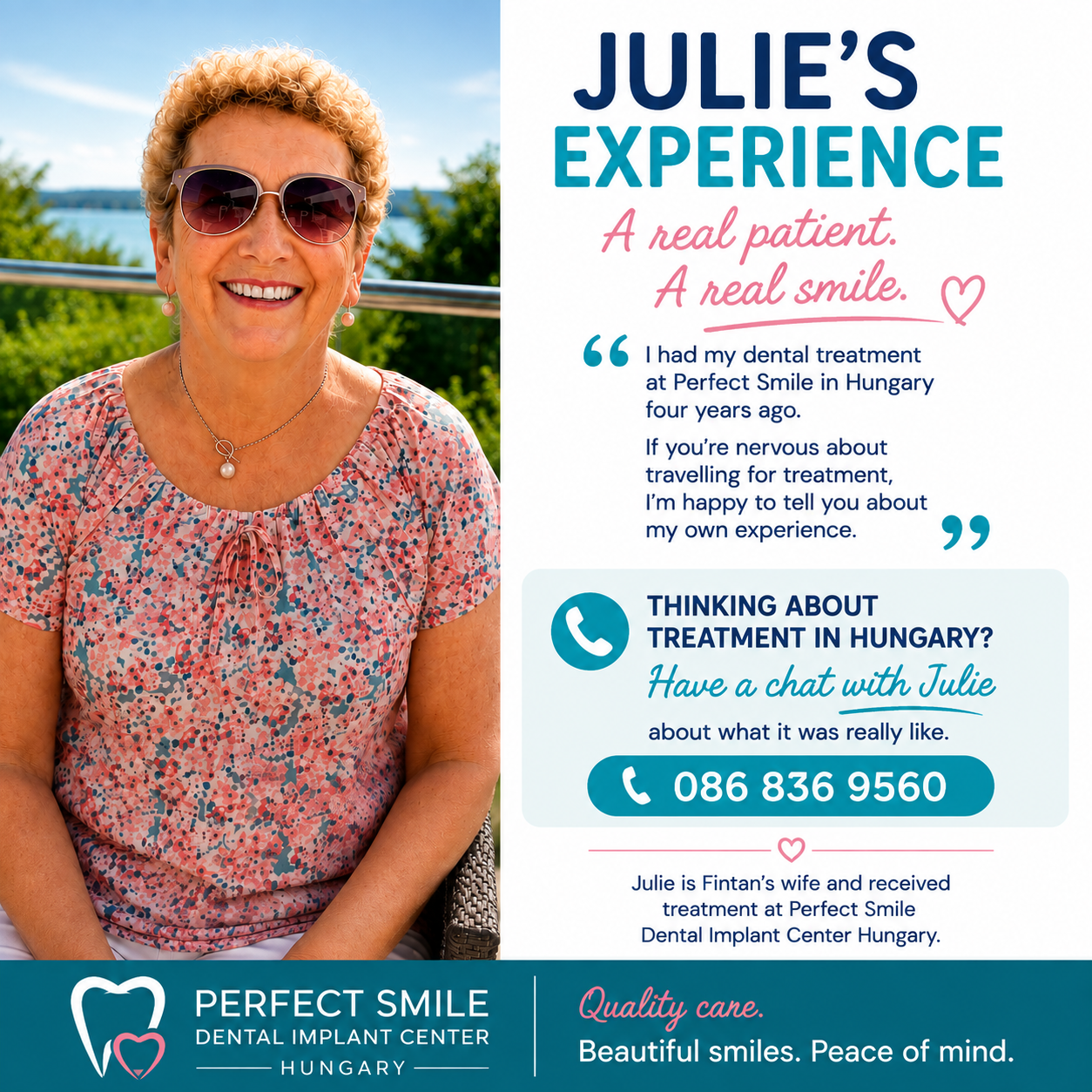
Julie isn’t a stock photograph or an anonymous online review.
She travelled to Perfect Smile Dental Implant Center in Hungary for her own dental treatment four years ago.
She’s also Fintan’s wife.
We think that’s important to tell you openly.
Julie isn’t presented here as an independent reviewer of our business. She’s a real patient who has actually experienced the journey that prospective patients often have questions about.
She knows what it feels like to consider treatment, travel to Hungary, visit Perfect Smile and return home afterwards.
If you’re nervous about travelling for treatment and would simply like to speak to someone who has actually done it, Julie is happy to talk about her own personal experience.
Call Julie: 086 836 9560
You can also read more dental treatment abroad testimonials from patients who have shared their experiences.
Affordable Dental Tourism in 2026: What Does “Affordable” Really Mean?
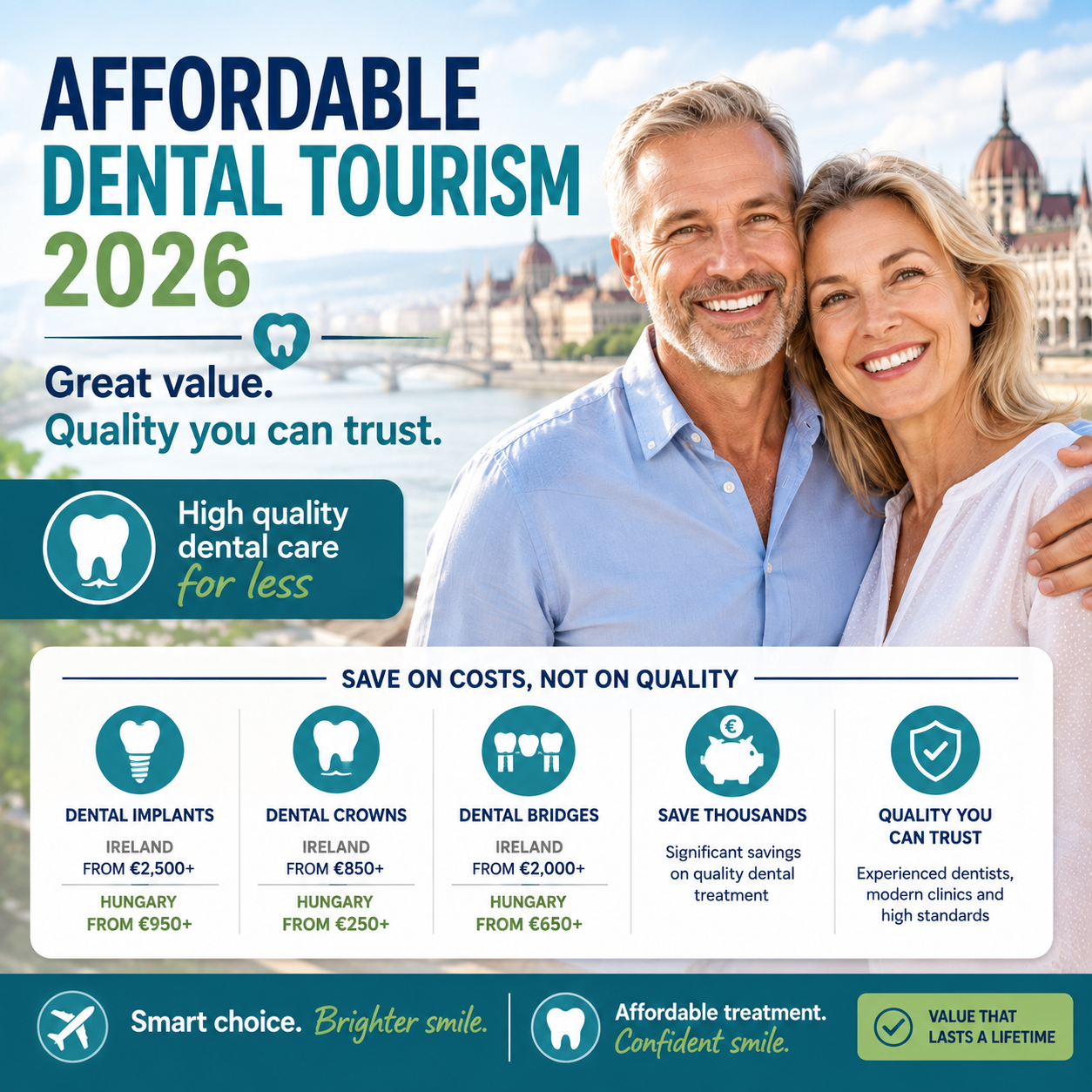
There’s an important distinction between cheap dental treatment and affordable dental treatment.
They aren’t necessarily the same thing.
The cheapest possible treatment is rarely a sensible objective.
What most people actually want is appropriate treatment from experienced professionals at a price they can afford.
When considering affordable dental tourism in 2026, look at the complete picture.
Depending on your circumstances, your overall costs could include:
- Dental treatment
- Flights
- Accommodation
- Transport
- Time away from work
- Additional visits
- Follow-up care
- Possible return trips
Only then can you make a meaningful comparison.
A treatment option that costs slightly more but gives you greater confidence in the treatment plan, communication and aftercare could represent better value than simply choosing the lowest quotation.
Affordable dental tourism should be about value — not just finding the cheapest price.
Dental Tourism in Hungary: Why Do Patients Consider Hungary?
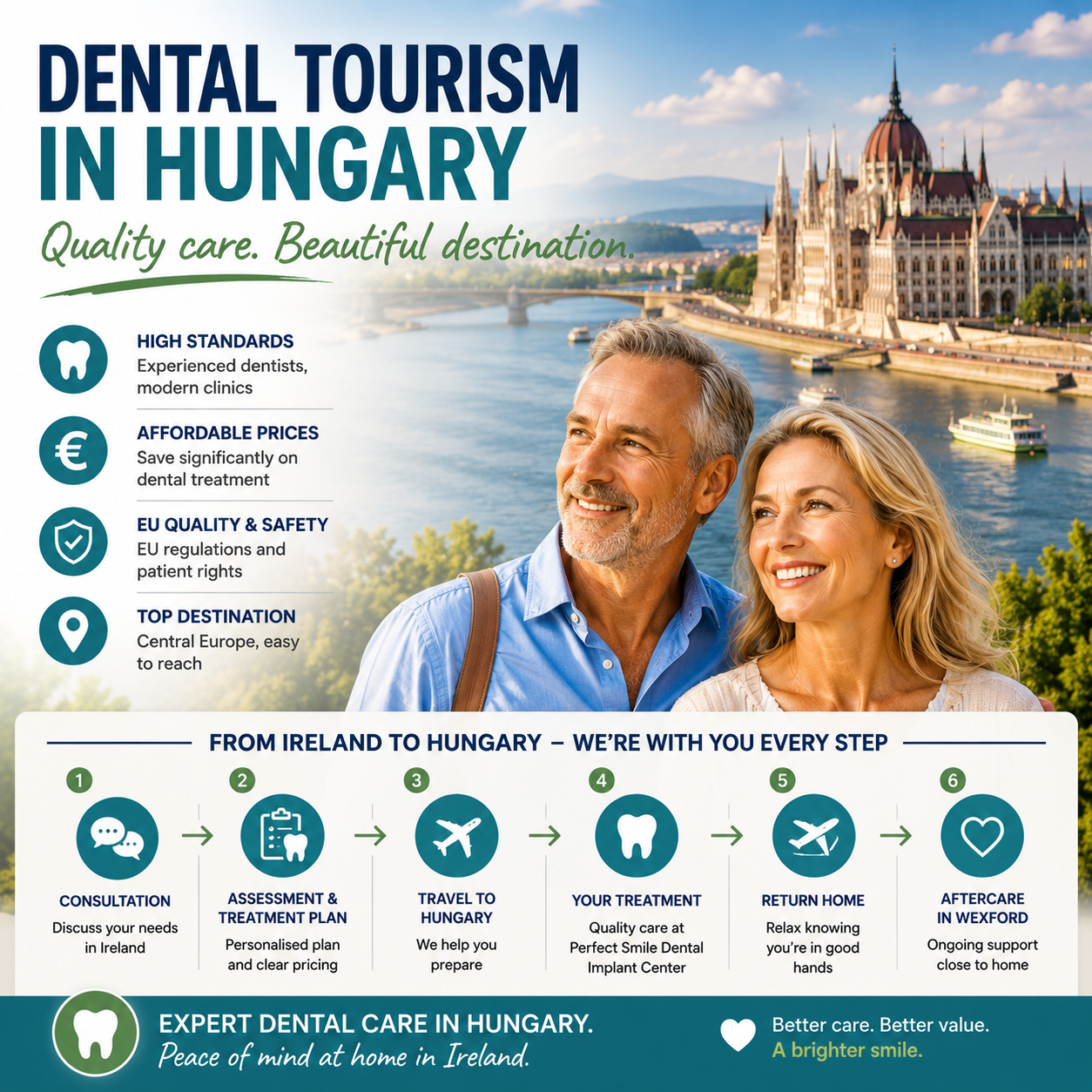
Dental tourism in Hungary has become familiar to many European patients considering private dental treatment abroad.
For someone travelling from Ireland, one important point is that both Ireland and Hungary are EU member states.
The EU’s cross-border healthcare framework provides patients with access to official information about receiving healthcare in another EU country. National Contact Points are available to help people understand matters such as healthcare arrangements, patients’ rights, quality and safety information and, where relevant, reimbursement rules.
That doesn’t mean every Hungarian dentist or clinic is automatically the right choice.
The same rule still applies:
Research the individual dentist, the clinic and your proposed treatment.
What Happens If Something Goes Wrong When You Come Home?
This may be one of the most important questions to ask before having dental treatment abroad.
Imagine you’re home in Ireland and something doesn’t feel right.
Who do you call?
Do you contact the treating clinic in Hungary?
Is there someone in Ireland you can speak to?
Would you need to return to Hungary?
What constitutes an emergency?
Don’t wait until something happens to discover the answers.
Ask before treatment begins.
EU cross-border healthcare information also explains how patients can obtain information about their rights and relevant procedures when receiving healthcare in another EU member state.
However, knowing your rights doesn’t replace having a sensible plan for what happens after treatment.
Why Aftercare Matters Just as Much as the Treatment
People understandably spend a lot of time researching dental implants, crowns and dentists.
Aftercare sometimes receives much less attention.
That’s a mistake.
Extensive dental treatment can represent a major investment in your health, comfort and appearance.
Before travelling abroad, ask what ongoing maintenance will be required.
Depending on your treatment and individual dental needs, ongoing care could involve:
- Routine dental examinations
- Professional cleaning
- Implant checks
- X-rays when clinically appropriate
- Periodontal care
- Maintenance or adjustments
Ask the treating dentist what long-term care is recommended for your particular treatment and establish where that care can be provided after you return home.
From Ireland to Hungary: What Can the Process Look Like?
One reason people hesitate about dental tourism is simply because they don’t know what happens next.
The process can seem much less intimidating when it’s broken into stages.
For someone considering treatment with Perfect Smile Dental Implant Center Hungary through Hungarian Dental Implant Centre Wexford, the journey can begin here in Ireland.
Step 1: Start With a Conversation
Before booking flights or committing to treatment, you can contact us in Wexford and discuss what you’re considering.
That gives you an opportunity to ask questions without immediately committing to travelling abroad.
Step 2: Initial Assessment
An appropriate assessment helps establish what dental treatment may be required.
Every patient is different, so meaningful treatment planning should be based on the individual’s dental condition rather than simply choosing an advertised treatment package.
Step 3: Understand the Proposed Treatment and Costs
Before deciding whether to proceed, make sure you understand the proposed treatment, anticipated stages and expected costs.
This is the time to ask questions.
Step 4: Travel to Hungary for Treatment
If you decide to proceed, treatment takes place at Perfect Smile Dental Implant Center in Hungary.
The length and number of visits depend upon the treatment required and your individual clinical circumstances.
Step 5: Return to Ireland
When the appropriate treatment stage has been completed, you return home.
If further treatment stages are necessary, these should form part of the treatment planning process.
Step 6: Aftercare and Support in Wexford
One of the reassuring aspects of this arrangement is having a point of contact in Wexford.
Instead of feeling that your connection ends when your flight leaves Hungary, you know who you can contact when you’re back in Ireland.
The exact follow-up or aftercare clinically appropriate for you will depend on the treatment you’ve received and should always be discussed individually.
Treatment in Hungary. Support in Wexford.

There’s a big difference between finding an overseas dental clinic online and being able to speak to someone locally.
A website can answer many questions.
A price list can provide guidance.
Patient testimonials can tell you about other people’s experiences.
But sometimes you simply want to talk to a human being.
You might want to ask:
- Have other people from Ireland actually done this?
- What is the clinic like?
- How long might I be away?
- What happens when I come home?
- Can I speak to someone before deciding?
That’s one of the reasons Hungarian Dental Implant Centre Wexford exists.
The first step doesn’t have to be getting on an aeroplane.
It can simply be getting more information.
Questions to Ask a Dental Clinic Abroad Before Booking
If you’re wondering how to find a dentist abroad, these are some of the most useful questions to ask before committing to treatment:
Who will perform my treatment?
Ask who will be responsible for the treatment and what relevant qualifications and experience they have.
Is the dentist professionally registered?
Ask how their professional status can be independently checked.
What exactly does my treatment plan include?
Request clear information about the proposed treatment and ask questions about anything you don’t understand.
What is included in the expected price?
Find out what circumstances could potentially alter the final cost.
What implant system or materials will be used?
Ask what records you’ll receive regarding the products used during treatment.
How many trips might I need?
Don’t assume extensive treatment can always be completed in a single visit.
How long should I remain in the country?
The answer should reflect your individual treatment and clinical requirements.
What happens if there is a complication?
Get a clear explanation before treatment begins.
What guarantee is provided?
If there is a guarantee, read its terms and conditions rather than relying on the headline promise.
What aftercare will I need?
Ask what happens after you return home and what ongoing care is recommended.
Red Flags When Choosing a Dentist Abroad
When you’re learning how to find a dentist abroad, knowing what should make you cautious is just as important as knowing what to look for.
Take additional care if:
- You’re pressured to pay immediately
- The clinic won’t identify who will treat you
- Prices aren’t clearly explained
- You can’t obtain a meaningful treatment plan
- Questions about complications are avoided
- Nobody explains aftercare
- Extraordinary results are guaranteed
- The treatment timetable appears driven primarily by travel convenience
- You’re being encouraged towards extensive treatment without an appropriate assessment
One of the simplest rules is also one of the best:
If something doesn’t feel right, don’t rush.
Give yourself time to ask another question or obtain another professional opinion.
Is Dental Treatment Abroad Right for Everyone?
No.
And any responsible discussion of dental tourism should say that.
Some people may decide that being treated close to home is more important than potential savings.
Others may have medical or dental circumstances that make travelling less practical.
Some treatments may involve multiple appointments or lengthy healing periods.
Others may simply prefer not to travel.
Those are all legitimate considerations.
Dental tourism is an option, not an obligation.
The purpose of researching affordable dental tourism in 2026 is to establish whether travelling for treatment could be suitable for your own circumstances.
Don’t Let Price Make the Decision for You
It’s easy to become focused on numbers.
Treatment at home costs one amount.
Treatment abroad costs another.
Therefore, choose the cheaper one.
Real life isn’t quite that simple.
A better comparison is:
What treatment am I receiving, who is providing it, what materials are being used, what support will I receive and what is the overall expected cost?
Then compare your options.
Saving money can certainly matter.
But confidence in the people treating you matters too.
Dental Tourism in Hungary: Start With Research, Not a Flight
If you’re considering dental tourism in Hungary, you don’t need to make the entire decision today.
Research the treatment.
Research the dentist.
Research the clinic.
Read genuine dental work abroad testimonials.
Ask about prices.
Ask difficult questions.
Understand the benefits, limitations and risks of the treatment being proposed.
And establish what happens when you return home.
That’s how you turn dental tourism from something unfamiliar into a more informed decision.
Frequently Asked Questions About Dental Work Abroad
How do I find a good dentist abroad?
Start by researching the individual dentist rather than choosing solely by country or clinic. Check professional credentials and registration where possible, investigate the clinic independently, obtain a clear treatment plan, understand the expected costs and ask about complications and aftercare before booking.
Is it safe to have dental treatment abroad?
Dental treatment is available in many countries, but travelling abroad doesn’t remove the normal risks associated with dental procedures. Suitability and risk depend on the treatment, practitioner and individual patient. Research carefully and discuss your proposed treatment with appropriately qualified dental professionals.
Why do people travel to Hungary for dental treatment?
Hungary is one of the European destinations considered by international dental patients, including people looking at implants, crowns and restorative dentistry. Cost may be an important factor, but the dentist, clinic, treatment plan, travel requirements and aftercare should also form part of the decision.
Should I trust dental work abroad testimonials?
Testimonials can be useful, particularly detailed patient stories describing the complete experience. However, they shouldn’t be your only source of information. Independently research the dentist and clinic and ask questions relevant to your own proposed treatment.
Can I speak to somebody who has actually had treatment at Perfect Smile?
Yes. Julie had her own dental treatment at Perfect Smile Dental Implant Center Hungary four years ago and is happy to talk about her personal experience. Julie is Fintan’s wife, which we disclose openly. You can call Julie on 086 836 9560.
Is the cheapest dentist abroad the best choice?
Not necessarily. Compare the complete treatment and overall expected costs rather than focusing only on an advertised price. Consider the dentist’s experience and credentials, treatment plan, materials, number of visits, travel costs, aftercare and arrangements if additional treatment becomes necessary.
How many times will I need to travel for dental treatment?
That depends on the procedure and your individual circumstances. Some treatments involve healing periods and several stages. Your treating dentist should explain the expected timetable for your particular case.
What happens if I have problems after dental treatment abroad?
Ask this before booking. Find out what support the treating clinic provides, whether returning to the clinic could be necessary, what guarantees apply and what local support or aftercare is available.
Considering Dental Treatment in Hungary?
If you’re in Ireland and considering travelling to Hungary for dental treatment, you can begin by simply finding out what’s involved.
Hungarian Dental Implant Centre Wexford works with Perfect Smile Dental Implant Center Hungary, giving prospective patients an opportunity to make enquiries here in Ireland before deciding whether treatment in Hungary may be suitable for them.
You can ask about the process, travelling to Hungary and what happens after you return home.
Sometimes the best first step is simply asking the questions that are worrying you.
Call Fintan: 087 349 0104 Talk to Julie: 086 836 9560Independent Information Before You Decide
Before travelling for dental treatment, it’s worth consulting information that doesn’t come from a dental tourism company.
The Dental Council of Ireland provides guidance on choosing a dentist at home or abroad.
The European Commission provides official information about cross-border healthcare, including information about patients’ rights, quality and safety and National Contact Points.
You can also consult the EU’s National Contact Point information for cross-border healthcare if you want further information about receiving healthcare in another EU country.
Make an Informed Decision
Travelling abroad for dental treatment is a major decision.
For some patients, affordable dental tourism in 2026 may provide another option when considering extensive dental treatment.
But affordability shouldn’t come at the expense of asking the right questions.
Find out who will treat you.
Check their credentials.
Understand your treatment plan.
Know the expected costs.
Ask about the materials being used.
Read real patient experiences.
Understand the treatment timetable.
And above all, establish what happens when you come home.
If you’re considering dental treatment with Perfect Smile Dental Implant Center Hungary, contact Hungarian Dental Implant Centre Wexford to learn more about the process.
Because when it comes to dental treatment abroad, the best decision isn’t necessarily the cheapest one.
It’s the one you can make with confidence.
This article provides general information and is not a substitute for individual dental or medical advice. Treatment suitability, risks, benefits and expected outcomes should be discussed with an appropriately qualified dental professional.