Why do my teeth feel loose? It’s a worrying question, particularly when an adult tooth begins to move unexpectedly.
Unlike children’s baby teeth, permanent adult teeth should normally remain firmly supported by the surrounding gums and jawbone. If you notice movement, discomfort or changes in the position of a tooth, it’s important to find out why.
At Hungarian Dentists Wexford, we offer free consultations to help patients understand their dental concerns and explore suitable treatment options.
What Are the Causes of Loose Teeth?
Several conditions can cause adult teeth to become loose. Some develop gradually, while others occur suddenly following an injury.
1. Gum Disease and Periodontitis
One of the most common causes of loose adult teeth is advanced gum disease, known as periodontitis.
Periodontitis involves inflammation and destruction of the tissues and bone supporting the teeth. As this support is lost, teeth may begin to move.
Warning signs can include bleeding gums, gum recession, persistent bad breath, changes in your bite and teeth becoming loose.
Early assessment and appropriate periodontal treatment can help control the disease and reduce the risk of further tooth loss.
2. Injury or Trauma
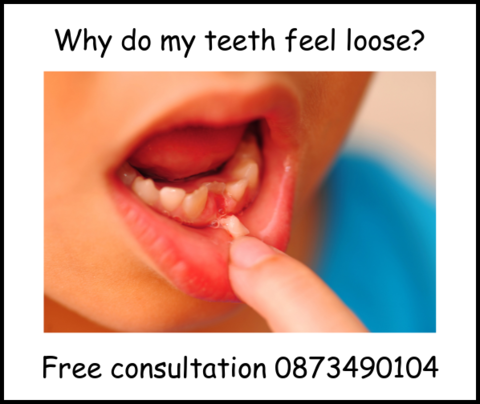
A fall, sporting accident or direct blow to the mouth can damage the structures holding a tooth in place.
A tooth may become loose even when there is no obvious crack or break.
If a permanent tooth becomes loose after an injury, seek urgent dental assessment. Avoid chewing on the affected tooth or trying to move it back into position yourself.
3. Teeth Grinding and Clenching
Bruxism is the medical term for grinding or clenching your teeth, often during sleep.
Excessive pressure can contribute to tooth mobility, particularly where the supporting tissues are already weakened.
A dentist may recommend a protective night guard or other treatment depending on the cause.
4. Bone Loss Around the Teeth
The jawbone provides essential support for your teeth.
When bone is lost because of advanced periodontal disease or other dental conditions, teeth can become less stable.
A dental examination and appropriate X-rays can help establish how much supporting bone remains.
5. Smoking and Other Risk Factors
Smoking increases the risk of periodontal disease and can interfere with healing.
Other factors, including poorly controlled diabetes and certain medical conditions, may also influence gum health and the supporting tissues.
Identifying these factors helps a dentist recommend appropriate treatment.
Can a Loose Adult Tooth Tighten Up Again?
Sometimes, yes. Whether a loose tooth can become stable again depends on why it became loose and how much damage has occurred.
If mobility is associated with inflammation or excessive biting pressure, treating the underlying problem may improve stability.
However, advanced loss of supporting bone may not be reversible, and some teeth cannot be saved.
Do not wait for a loose adult tooth to tighten on its own. Early dental assessment gives you the best opportunity to identify the problem and discuss appropriate treatment.
What Treatments Are Available for Loose Teeth?
There is no single treatment suitable for every loose tooth. A dentist must first establish the underlying cause.
1. Periodontal Treatment
When gum disease is responsible, treatment may involve professional cleaning, scaling and root surface debridement, improved oral hygiene and ongoing periodontal maintenance.
The aim is to control inflammation and prevent further destruction of the supporting tissues.
2. Dental Splinting
Dental splinting involves joining a mobile tooth to neighbouring teeth to provide additional support.
It may be suitable in selected cases, but it does not replace treatment for gum disease or other underlying problems.
3. Bite Adjustment or a Night Guard
Where excessive biting forces contribute to the problem, a dentist may recommend managing teeth grinding or adjusting how the teeth meet.
The appropriate approach depends on a full dental assessment.
4. Bone Grafting
In selected cases, periodontal regenerative procedures may help repair certain types of bone defects.
However, bone grafting is not suitable for every loose tooth and cannot reliably restore all bone that has been lost.
5. Root Canal Treatment
If a tooth has an infected or damaged pulp, root canal treatment may be recommended.
Root canal treatment addresses problems inside the tooth. It does not, by itself, restore supporting bone lost through gum disease.
6. Tooth Extraction and Replacement
Sometimes a tooth is too badly damaged or has lost too much support to be saved.
When extraction is necessary, replacement options may include dental implants, bridges or dentures.
The most appropriate solution depends on your oral health, available bone, neighbouring teeth and individual treatment needs.
What Should You Do If Your Tooth Feels Loose?
- Arrange a dental appointment promptly.
- Avoid biting hard foods with the affected tooth.
- Do not repeatedly wiggle or test the tooth.
- Continue gentle brushing and cleaning around the area.
- Seek urgent dental care after an injury, or if you develop significant swelling, fever or severe pain.
If you experience facial swelling with difficulty breathing or swallowing, seek emergency medical care immediately.
Frequently Asked Questions
Is it normal for adult teeth to move slightly?
Teeth have a small amount of natural movement because they are supported by periodontal ligaments. However, noticeable new movement should be assessed by a dentist.
Can gum disease cause teeth to fall out?
Yes. Advanced periodontal disease can damage the tissues and bone supporting teeth, eventually leading to tooth loss if the disease is not controlled.
Can a loose tooth be saved?
Some loose teeth can be stabilised or retained with appropriate treatment. The outcome depends on the cause, degree of mobility and condition of the surrounding bone and gums.
Should I have a loose tooth removed?
Not necessarily. Extraction should be considered only after a dentist has assessed whether the tooth can reasonably be preserved.
Can dental implants replace missing teeth?
Dental implants may be an option after tooth loss, provided the patient’s oral health, bone support and other clinical factors make implant treatment suitable.
Dental Consultations in Wexford and Treatment in Hungary
If you are concerned about loose teeth, missing teeth or the condition of your gums, Hungarian Dentists Wexford can help you take the first step towards understanding your options.
We offer a free consultation and panoramic X-ray in Wexford. Individual treatment plans are coordinated with Perfect Smile Dental Implant Center in Hódmezővásárhely, Hungary.
Where patients decide to proceed, dental treatment is carried out in Hungary, apart from preparatory extractions that may be performed in Wexford. Follow-up appointments and aftercare are available through our Wexford clinic.
Any urgent dental problem should be assessed promptly rather than waiting for a scheduled consultation.
Arrange Your Free Dental Consultation
Speak with Fintan at Hungarian Dentists Wexford about your dental concerns and the next steps.
Call: 087 349 0104
Conclusion
If you’ve been asking yourself, “Why do my teeth feel loose?”, the most important step is to establish the cause.
Gum disease, injury, grinding and loss of supporting bone are all possible explanations. Some teeth can be preserved with appropriate treatment, while others may require replacement.
A professional dental assessment can help you understand your options and make an informed decision about your oral health.