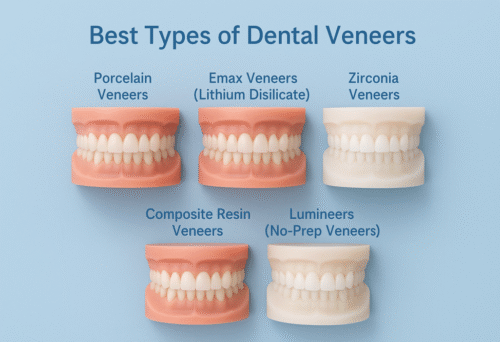
What are the best types of dental veneers? Porcelain and E-max ceramic veneers are popular for natural-looking, long-lasting results, while composite veneers can be a more affordable option. The right choice depends on your teeth, bite, expectations and budget.
If you are unhappy with chipped, stained, uneven or slightly spaced front teeth, veneers may improve their appearance. However, they are not suitable for everyone, and healthy tooth structure should be preserved wherever possible.
At Hungarian Dentists Wexford, you can arrange a free dental consultation and panoramic X-ray in Wexford. If veneers are appropriate, treatment takes place at Perfect Smile Dental Implant Center Hungary, with reviews and aftercare coordinated in Wexford.

What Are Dental Veneers?
Dental veneers are thin layers of tooth-coloured material placed over the visible surface of a tooth. They can improve the appearance of discolouration, chips, irregular shapes and small spaces between teeth.
Some veneers are made in a dental laboratory and bonded to prepared teeth. Others are built directly onto the teeth using composite resin. Veneers are primarily cosmetic: significant tooth decay, gum disease or bite problems may need treatment first.
The Best Types of Dental Veneers Explained
1. Porcelain Veneers
Porcelain veneers are custom-made ceramic restorations designed to resemble natural enamel. They resist staining and can provide an attractive finish.
Considerations: They generally cost more than composite veneers and often require some irreversible enamel preparation. They can chip or debond and may eventually need replacement.
2. E-max Veneers
E-max is a brand of lithium-disilicate glass ceramic, valued for its translucency and aesthetics. It is one type of ceramic veneer rather than an entirely separate alternative to porcelain.
Considerations: The amount of tooth preparation depends on the case. E-max is not automatically the strongest or best choice for every bite.
3. Zirconia Veneers
Zirconia is a strong dental ceramic that may be considered for selected restorations, especially when masking darker underlying tooth colour is important.
Considerations: It is less commonly used for thin bonded veneers than glass ceramics. Greater material strength does not make zirconia the right choice for teeth grinding; that requires an individual assessment.
4. Composite Resin Veneers
Composite veneers are made from tooth-coloured resin and may be shaped directly on the teeth, sometimes in one appointment.
Considerations: They are often less expensive and easier to repair, but tend to stain, wear and lose polish sooner than ceramic veneers.
5. No-Prep or Minimal-Prep Veneers
Very thin veneers, including products marketed as Lumineers, may require little or no enamel removal in suitable cases.
Considerations: They are not suitable for every tooth shape or alignment. Adding material without preparation can sometimes make teeth look bulky, and removal is not guaranteed to be fully reversible.

Dental Veneer Types Compared
| Type | Main advantage | Main consideration |
|---|---|---|
| Porcelain | Natural appearance and stain resistance | Higher initial cost; preparation often required |
| E-max ceramic | Excellent translucency and aesthetics | Suitability depends on bite and tooth structure |
| Zirconia | Strong ceramic material | Not the usual first choice for thin cosmetic veneers |
| Composite | Often lower cost and repairable | More prone to staining and wear |
| No-prep | May preserve more enamel in selected cases | Not suitable for every smile or tooth position |
How Do You Choose the Right Veneers?
The best type of dental veneers for you depends on more than the material. Your dentist should assess:
- Tooth and gum health, including existing fillings or decay
- Tooth position, bite and any grinding or clenching
- How much enamel is available for bonding
- The colour, shape and appearance you hope to achieve
- Maintenance, likely future repairs and overall treatment cost
Veneers may not be the best solution for every concern. Depending on the problem, whitening, orthodontic treatment, composite bonding or a crown may be more appropriate.

How Long Do Dental Veneers Last?
Ceramic veneers can last for many years, often around a decade or longer with appropriate care, although results vary. Composite veneers may need polishing, repair or replacement sooner. No veneer type is guaranteed to last a particular number of years.
Good oral hygiene, regular dental reviews and avoiding habits such as biting hard objects help protect veneers. If you grind your teeth, your dentist may recommend additional precautions.
Are Veneers Cheaper in Hungary Than Ireland?
Dental treatment in Hungary may cost less than at some private clinics in Ireland, particularly when several teeth require treatment. However, a meaningful comparison must use the same veneer material and treatment scope and include travel, accommodation, any preparatory work and follow-up care.
We have not included unverified per-veneer prices here. Your written treatment plan should specify the material, number of veneers and full proposed cost. You can also read our guide to dental veneer prices.
Free Consultation in Wexford, Treatment in Hungary
Hungarian Dentists Wexford has supported Irish patients arranging dental treatment in Hungary for more than 24 years. Your first step can be a free consultation and panoramic X-ray in Wexford.
- Consultation in Wexford: Discuss your concerns and have your teeth assessed.
- Individual treatment plan: The clinical information is reviewed with the team in Hungary, and a proposed plan is sent to you.
- Decide whether to travel: You can review the treatment and cost before making a decision.
- Dental treatment in Hungary: If you proceed, veneers and other restorative work are carried out at Perfect Smile Dental Implant Center Hungary in Hódmezővásárhely.
- Aftercare in Wexford: Appropriate follow-up appointments and reviews can be arranged locally with the visiting dental team.
Patients arrange and pay for their own flights; the treatment coordinator in Hungary can assist with accommodation and airport transfers.
Thinking About Dental Veneers?
Find out which treatment may be right for you with a free consultation and panoramic X-ray in Wexford.

Fintan Duggan – Your Local Contact in Wexford
Call 087 349 0104
Free X-Ray & ConsultationFrequently Asked Questions
Which dental veneers look most natural?
Well-planned porcelain and E-max ceramic veneers can look very natural. The result also depends on shade matching, tooth preparation and the dentist’s design.
Are E-max veneers better than composite veneers?
E-max ceramic generally offers better stain resistance and may last longer, while composite often costs less and is easier to repair. The best option depends on your circumstances.
Can veneers damage natural teeth?
Traditional veneers often require removal of some enamel, which cannot grow back. A dentist should explain the preparation required, possible complications and alternatives before treatment.
Can veneers straighten crooked teeth?
Veneers can disguise minor irregularities but do not move teeth. Orthodontic treatment may be more suitable for significant crowding or bite problems.
Can I have my veneer consultation in Wexford?
Yes. Hungarian Dentists Wexford offers a free consultation and panoramic X-ray. Any veneer treatment itself is carried out at Perfect Smile Dental Implant Center Hungary.
Further reading: Published research on ceramic veneers. This article provides general information and is not a substitute for an individual dental examination.