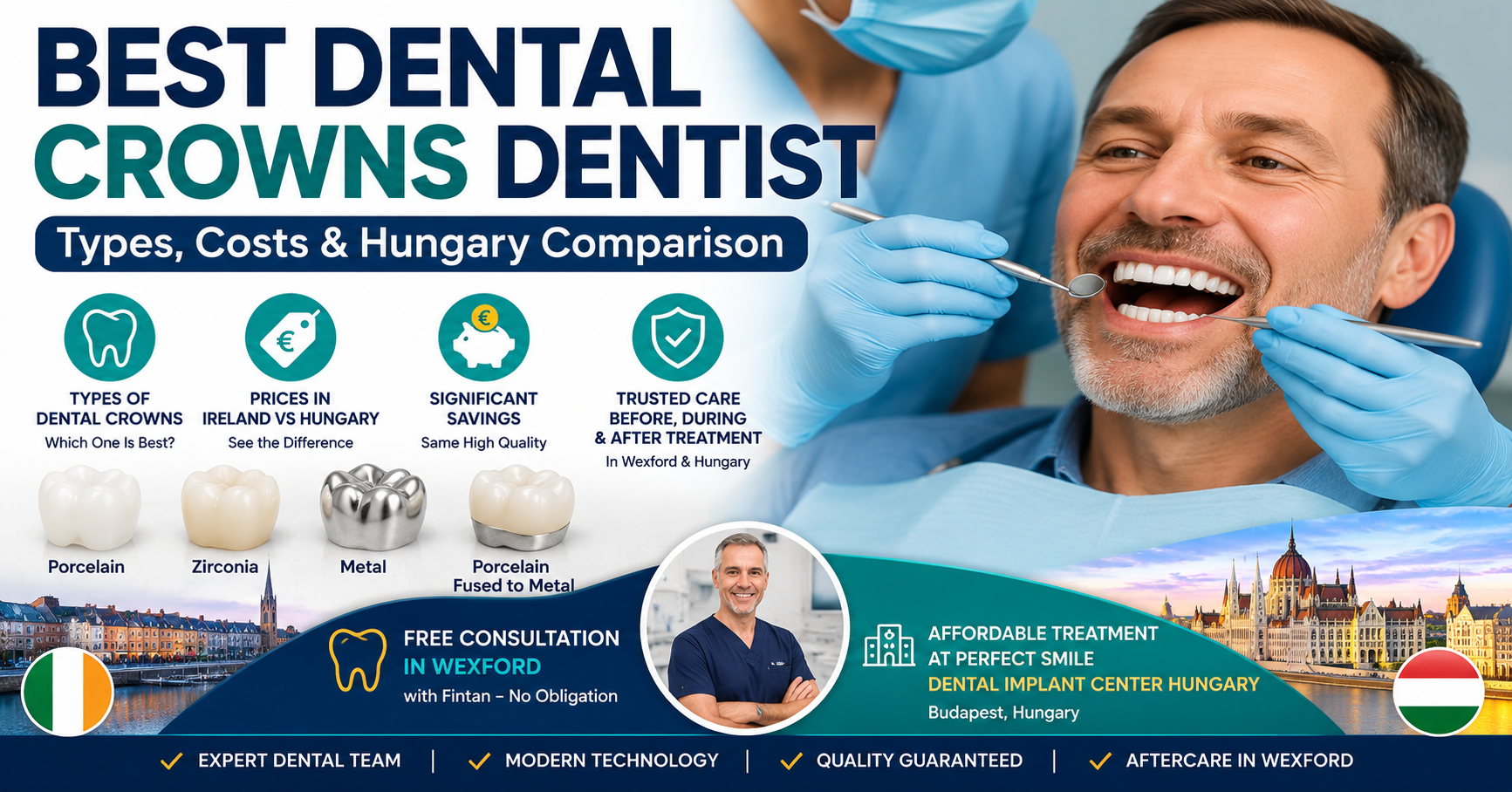
Best Dental Crowns in 2026: Types, Costs and Which to Choose
Choosing the best dental crowns depends on several factors, including which tooth needs treatment, how much natural tooth remains, your bite, appearance preferences and budget. Zirconia, Emax, porcelain and porcelain-fused-to-metal crowns each offer different advantages.
If you are considering dental crowns but are concerned about the cost in Ireland, Perfect Smile Dental Implant Center Hungary offers professionally planned dental crown treatment, with prices ranging from €265 to €365 per crown.
Through Hungarian Dentists Wexford, patients can begin with a free dental consultation and panoramic X-ray in Wexford before deciding whether to travel to Hungary for treatment.
The best dental crown is the one that suits your individual tooth and clinical needs. Zirconia is often chosen for strength, Emax for its natural appearance, and porcelain-fused-to-metal for its established combination of strength and aesthetics.
€265–€365 per crown
Current dental crown price range at Perfect Smile Dental Implant Center Hungary. Your individual treatment plan will confirm the material and total cost.
What Is a Dental Crown?
A dental crown is a custom-made restoration designed to cover and protect a damaged, weakened or heavily restored tooth.
Dental crowns can restore the tooth’s shape, appearance and chewing function while helping protect the remaining natural tooth structure.
A dentist may recommend a crown for several reasons:
- A tooth has extensive decay or a large existing filling.
- A tooth is cracked, fractured or weakened.
- A tooth requires protection following root canal treatment.
- A tooth is badly worn or damaged.
- The appearance or shape of a tooth needs restoring.
- A crown is required as part of a dental implant restoration.
Not every damaged tooth needs a crown. Depending on the circumstances, a filling, onlay, veneer or another treatment may be more appropriate.

What Are the Best Types of Dental Crowns?
There is no single crown material that is best for every patient. Each material has particular strengths and limitations.
Zirconia Crowns
Often considered for: Patients needing a strong, metal-free restoration, particularly where chewing forces are high.
Zirconia offers excellent mechanical strength and can provide a natural-looking result.
Emax Crowns
Often considered for: Visible teeth where translucency and natural appearance are important.
Emax is a lithium disilicate glass-ceramic that combines attractive aesthetics with good strength.
Porcelain-Fused-to-Metal Crowns
Often considered for: Patients seeking an established restoration combining a metal framework with a tooth-coloured porcelain surface.
These crowns have been widely used for many years.
All-Ceramic Crowns
Often considered for: Patients prioritising a natural-looking, metal-free restoration.
Different ceramic materials offer different levels of strength, translucency and suitability.
Comparing the Best Dental Crowns
The following comparison highlights the main differences between commonly used crown materials.
| Crown type | Main advantage | Considerations |
|---|---|---|
| Zirconia | High strength and durability | Appearance varies by zirconia type; some are less translucent than glass ceramics. |
| Emax | Excellent natural appearance | Not suitable for every bite or restoration design. |
| Porcelain-fused-to-metal | Established combination of strength and appearance | Porcelain may chip, and metal margins can sometimes become visible. |
| All-ceramic | Metal-free aesthetics | Strength and longevity depend on the particular ceramic used. |

Zirconia Dental Crowns
Zirconia crowns are made from zirconium dioxide, a strong ceramic material widely used in modern restorative dentistry.
One of their main advantages is resistance to fracture, making them a useful option for many back teeth and patients with demanding chewing requirements.
Modern zirconia materials can also produce attractive results for visible teeth, although their translucency varies depending on the type selected.
Advantages of zirconia crowns
- High strength and fracture resistance
- Metal-free construction
- Suitable for many front and back teeth
- Can provide natural-looking results
Possible disadvantages
Some zirconia materials are less translucent than Emax. The final appearance also depends on the underlying tooth colour, crown thickness and laboratory design.
Careful finishing and polishing are important to minimise wear on opposing teeth.
Emax Dental Crowns
Emax crowns are made from lithium disilicate glass-ceramic, a material valued for its combination of strength and natural-looking translucency.
They are often considered for front teeth and other visible areas where matching the appearance of surrounding teeth is especially important.
Emax can also be used for selected back teeth when the dentist considers the material suitable for the patient’s bite and restoration requirements.
Advantages of Emax crowns
- Excellent aesthetic potential
- Natural-looking translucency
- Metal-free material
- Suitable for many single-tooth restorations
Possible disadvantages
Emax may not be the preferred choice for every patient with heavy grinding forces or limited space for the restoration.
The dentist must assess the tooth and bite before recommending the material.
Porcelain-Fused-to-Metal Dental Crowns
Porcelain-fused-to-metal crowns, often called PFM crowns, combine a metal substructure with an outer porcelain layer.
The metal framework provides structural support, while the porcelain is designed to resemble a natural tooth.
PFM crowns have a long clinical history and remain a suitable option for selected patients.
Advantages of PFM crowns
- Well-established restorative option
- Good structural strength
- Tooth-coloured external appearance
- Suitable for a range of clinical situations
Possible disadvantages
The porcelain surface can chip, and a darker metal margin may become visible if the gums recede.
They may also be less translucent than some all-ceramic restorations.
All-Ceramic and Porcelain Crowns
All-ceramic crowns contain no metal framework and can provide excellent aesthetic results.
The term covers several materials, including traditional porcelain-based ceramics and newer high-strength ceramics.
Traditional porcelain materials can produce a highly natural appearance, but some are more susceptible to fracture than zirconia or lithium disilicate.
The most appropriate material depends on the tooth’s location, the remaining tooth structure and the forces placed on the restoration.
Which Dental Crown Is Best for Front Teeth?
For front teeth, appearance is often a major consideration.
Emax and certain other all-ceramic crowns can be particularly suitable because of their ability to reproduce the translucency and colour of natural teeth.
Modern aesthetic zirconia crowns may also be appropriate.
However, the dentist must consider more than appearance. The patient’s bite, existing tooth colour, gum position and remaining tooth structure can all influence the final choice.
Which Dental Crown Is Best for Back Teeth?
Back teeth experience considerable pressure during chewing.
Zirconia is often considered for molars because of its high strength and resistance to fracture.
PFM and suitable lithium disilicate crowns may also be appropriate in certain circumstances.
The best choice depends on the available space, bite forces, tooth preparation and individual clinical assessment.
How Much Do Dental Crowns Cost in Hungary in 2026?
Dental crown prices at Perfect Smile Dental Implant Center Hungary range from €265 to €365 per crown, depending on the material and treatment requirements.
Confirmed crown price range
€265–€365
Per dental crown at Perfect Smile Dental Implant Center Hungary.
The final quotation will depend on the selected crown material and the patient’s treatment plan.
It is important to establish what is included in a quotation.
Some patients require additional treatment before a crown can be fitted, such as a root canal procedure, replacement of an old restoration or treatment for gum disease.
Any additional procedures should be explained in the written treatment plan.
Flights, accommodation and other travel expenses are separate considerations when comparing treatment in Ireland and Hungary.
A crown fitted to a natural tooth should also be distinguished from a crown used as part of a dental implant restoration, which may involve additional components and costs.
How Long Do Dental Crowns Last?
Many dental crowns remain functional for 10–15 years or longer, but there is no guaranteed lifespan for any crown material.
Some restorations last considerably longer, while others may need repair or replacement sooner.
The lifespan of a dental crown depends on several factors:
- The material and quality of the restoration
- The amount of healthy tooth structure remaining
- Daily brushing and cleaning between teeth
- Teeth grinding and clenching
- Diet and chewing habits
- Regular dental examinations
- Changes in the gums or supporting teeth
Good oral hygiene and appropriate professional care can help protect both the crown and the natural tooth beneath it.
For further reading, see this published research on dental crown outcomes.
How Long Does Dental Crown Treatment Take in Hungary?
For many patients requiring straightforward crown treatment, the planned dental work can be completed during a one-week stay in Hungary.
Patients commonly travel to Budapest on Sunday before being transferred to Hódmezővásárhely, where Perfect Smile Dental Implant Center Hungary is located.
Treatment appointments are generally arranged during the working week, with patients returning home towards the end of the week.
The process may include:
- Clinical examination and confirmation of the treatment plan.
- Preparation of the teeth requiring crowns.
- Dental impressions or digital scans.
- Laboratory fabrication of the restorations.
- Fitting and adjustment of the finished crowns.
Some patients require additional procedures or more time, so a one-week completion period cannot be guaranteed for every case.
Free Dental Consultation in Wexford Before Treatment
Irish patients considering dental crowns in Hungary can begin with a free consultation and panoramic X-ray through Hungarian Dentists Wexford.
A visiting dental team from Perfect Smile Hungary attends Wexford approximately every four weeks.
Following the initial consultation, the information is reviewed by the team in Hungary, and a personalised treatment plan is prepared.
Angelika Szmolka, the patient coordinator, helps patients understand their treatment arrangements and coordinates appointments, accommodation and transfers in Hungary.
Patients arrange and pay for their own flights.
Dental crown treatment takes place in Hungary, not Wexford. The Wexford clinic provides consultations, appropriate aftercare and follow-up appointments.
Patients can discuss their options and costs before deciding whether to proceed.
Dental Crown Aftercare in Wexford
Aftercare is an important consideration when choosing dental treatment abroad.
Patients who arrange treatment through Hungarian Dentists Wexford can access appropriate reviews and aftercare through the visiting Perfect Smile team.
The team normally visits Wexford approximately every four weeks.
If a patient experiences a problem after returning to Ireland, they should contact the clinic promptly rather than waiting for the next scheduled visit.
Urgent dental problems require timely assessment by an appropriate local dental professional.
Frequently Asked Questions About the Best Dental Crowns
What are the best dental crowns for natural-looking teeth?
Emax and other suitable all-ceramic crowns are often considered for visible teeth because of their natural-looking translucency. Modern zirconia can also provide attractive results.
Are zirconia crowns better than Emax?
Neither is automatically better. Zirconia is often preferred where high strength is important, while Emax is frequently chosen for its aesthetic properties. The best option depends on the individual tooth.
How much do dental crowns cost at Perfect Smile Hungary?
The confirmed 2026 price range is €265–€365 per crown. Additional treatment, where necessary, may be charged separately.
Can dental crowns be completed in one week?
Many straightforward cases can be completed during a planned one-week visit to Hungary. More complex treatment may require additional time or appointments.
Do dental crowns last forever?
No dental crown is guaranteed to last for life. Many last 10–15 years or longer, depending on the material, tooth condition, bite and maintenance.
Can I get dental crowns fitted in Wexford?
No. Crown treatment is provided at Perfect Smile Dental Implant Center Hungary. Consultations and appropriate aftercare are available through Hungarian Dentists Wexford.
Is the initial consultation in Wexford free?
Yes. Hungarian Dentists Wexford offers a free consultation and panoramic X-ray for patients considering planned dental treatment through Perfect Smile Hungary.
Choosing the Best Dental Crowns for Your Smile
The best dental crowns are not necessarily the most expensive or the strongest material available.
The right restoration must balance strength, appearance, suitability and long-term maintenance.
Zirconia, Emax, PFM and other ceramic crowns all have a place in modern dentistry, but the final choice should follow a professional assessment.
For Irish patients considering treatment abroad, Perfect Smile Dental Implant Center Hungary offers dental crowns priced from €265 to €365, with an initial consultation available in Wexford.

Interested in Dental Crowns in Hungary?
Arrange a free consultation and panoramic X-ray in Wexford to discuss your dental needs and explore treatment options at Perfect Smile Dental Implant Center Hungary.
Call Fintan: 087 349 0104 Contact Hungarian Dentists WexfordDental treatment in Hungary. Consultations and appropriate aftercare in Wexford.
Medical information: This article is intended for general information. The suitability of dental crowns, choice of materials, treatment times and final costs must be confirmed by the treating dental team. Prices supplied October 2026 and may change.