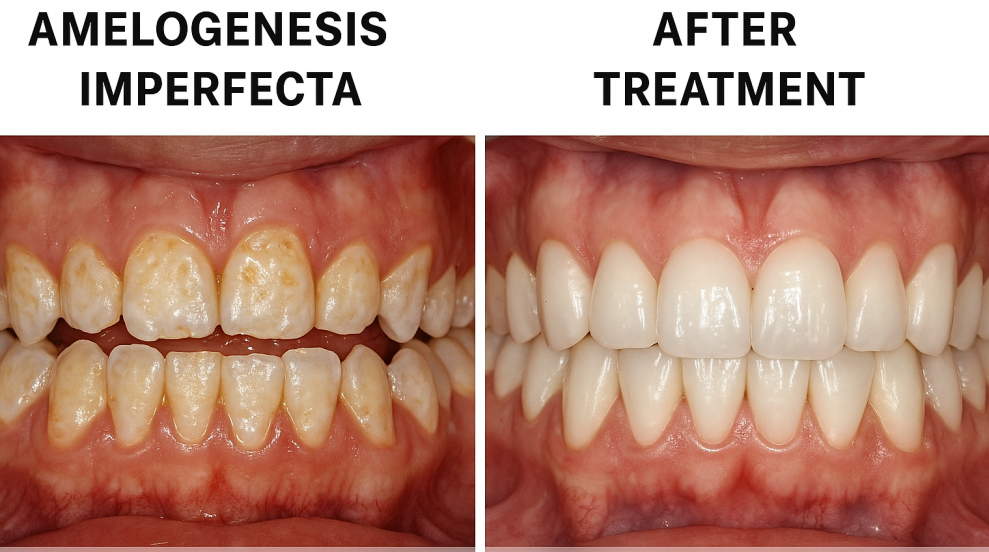
Amelogenesis Imperfecta: Causes and Treatment
Amelogenesis Imperfecta (AI) is a rare inherited condition that affects the development of tooth enamel.
Enamel is the hard, protective outer layer of teeth, and when it does not form properly, patients can experience a wide range of dental problems.
Although the condition is uncommon, it can have a significant impact on oral health, function, and appearance.
Understanding its causes and treatment options is essential for patients, families, and dental professionals.
If you have this inherited condition please get in touch with Fintan in Hungarian Dentists Wexford on 0873490104, we may be able to help you with treatment in Perfect Smile Hungary.
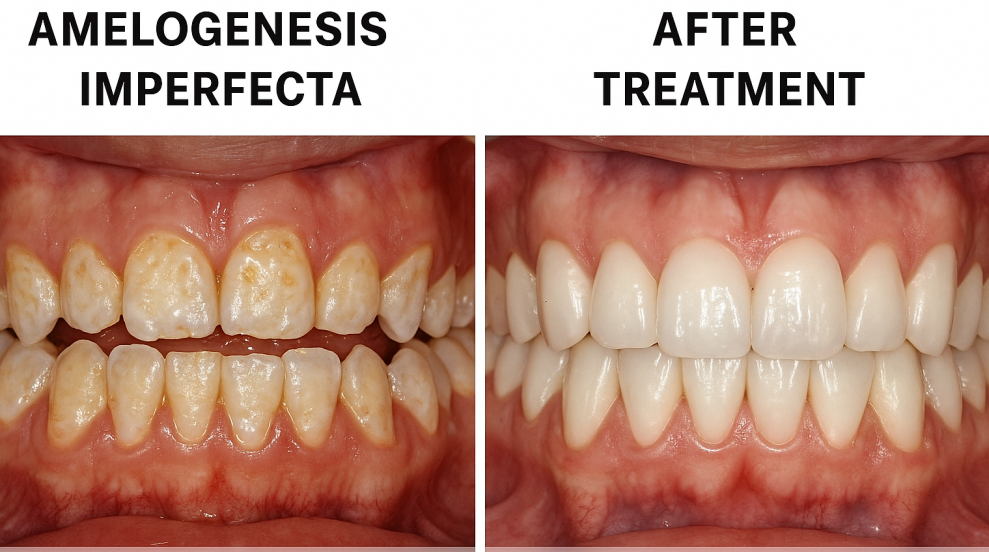
What is Amelogenesis Imperfecta?
Amelogenesis Imperfecta refers to a group of genetic disorders that interfere with the normal formation of enamel during tooth development.
It can affect both primary (baby) teeth and permanent (adult) teeth. Depending on the type and severity, enamel may be thin, soft, discolored, pitted, or even absent.
Teeth may appear yellow, brown, or gray and are often more prone to rapid wear, sensitivity, and breakage.
Causes of Amelogenesis Imperfecta
The primary cause of AI is genetic mutation. Several genes are responsible for the formation and mineralization of enamel, including AMELX, ENAM, MMP20, and KLK4.
Mutations in these genes disrupt the normal development process, leading to enamel defects.
AI can be inherited in different patterns:
- Autosomal dominant inheritance: Only one copy of the defective gene is enough to cause the condition.
- Autosomal recessive inheritance: Both parents must carry the gene mutation for the child to be affected.
- X-linked inheritance: The defective gene is located on the X chromosome, often affecting males more severely.
The condition occurs equally across genders and populations, though its severity may vary between families and even among siblings.
If you have this inherited condition please get in touch with Fintan in Hungarian Dentists Wexford on 0873490104, we may be able to help you with treatment in Perfect Smile Hungary.

Symptoms and Diagnosis
The clinical signs depend on the specific type of AI:
- Hypoplastic type: Enamel is thin, hard, and may appear pitted or grooved.
- Hypocalcified type: Enamel is of normal thickness but soft and weak, leading to rapid wear.
- Hypomaturation type: Enamel is softer than normal and may appear opaque or discolored.
- Mixed types: Features of more than one category may be present.
Patients with amelogenesis Imperfecta often report tooth sensitivity, aesthetic concerns, and functional problems such as difficulty chewing.
Dentists diagnose AI through family history, clinical examination, and in some cases genetic testing.
Treatment Options
There is currently no cure for Amelogenesis Imperfecta, but dental treatments can restore function, protect teeth, and improve aesthetics.
The approach depends on the patient’s age, the severity of enamel defects, and individual needs.
Common treatment strategies:
- Preventive Care
-
- Regular dental check-ups, fluoride applications, and good oral hygiene help prevent further damage and decay.
- Desensitizing toothpaste can reduce discomfort from sensitive teeth.
- Restorative Treatments
-
- Dental crowns and veneers are often used to cover defective enamel, improving strength and appearance.
- Composite bonding can repair small defects and protect exposed areas.
- Orthodontic and Prosthetic Options
-
- In severe cases, full mouth rehabilitation with crowns, bridges, or implants may be necessary.
- Orthodontic treatment may be required if enamel defects cause misalignment.
- Pediatric Management
-
- In children, stainless steel crowns are commonly used on molars to protect them until permanent teeth erupt.
Living with Amelogenesis Imperfecta
AI can have psychological as well as physical impacts, particularly for children and adolescents concerned about tooth appearance.
With proper dental care and early intervention, most patients can achieve a functional bite and a confident smile.
Regular collaboration between general dentists, prosthodontists, orthodontists, and genetic counselors is often needed to provide the best outcomes.

Conclusion
Amelogenesis Imperfecta is a genetic condition that compromises enamel quality, leading to weak, discolored, and sensitive teeth.
While it cannot be cured, modern dentistry offers effective solutions to restore strength and aesthetics.
Early diagnosis, preventive care, and personalized treatment plans ensure that patients with AI can enjoy long-term oral health and improved quality of life.
If you have this inherited condition please get in touch with Fintan in Hungarian Dentists Wexford on 0873490104, we may be able to help you with treatment in Perfect Smile Hungary.
References
https://pmc.ncbi.nlm.nih.gov/articles/PMC10765965/
https://pmc.ncbi.nlm.nih.gov/articles/PMC3178091/