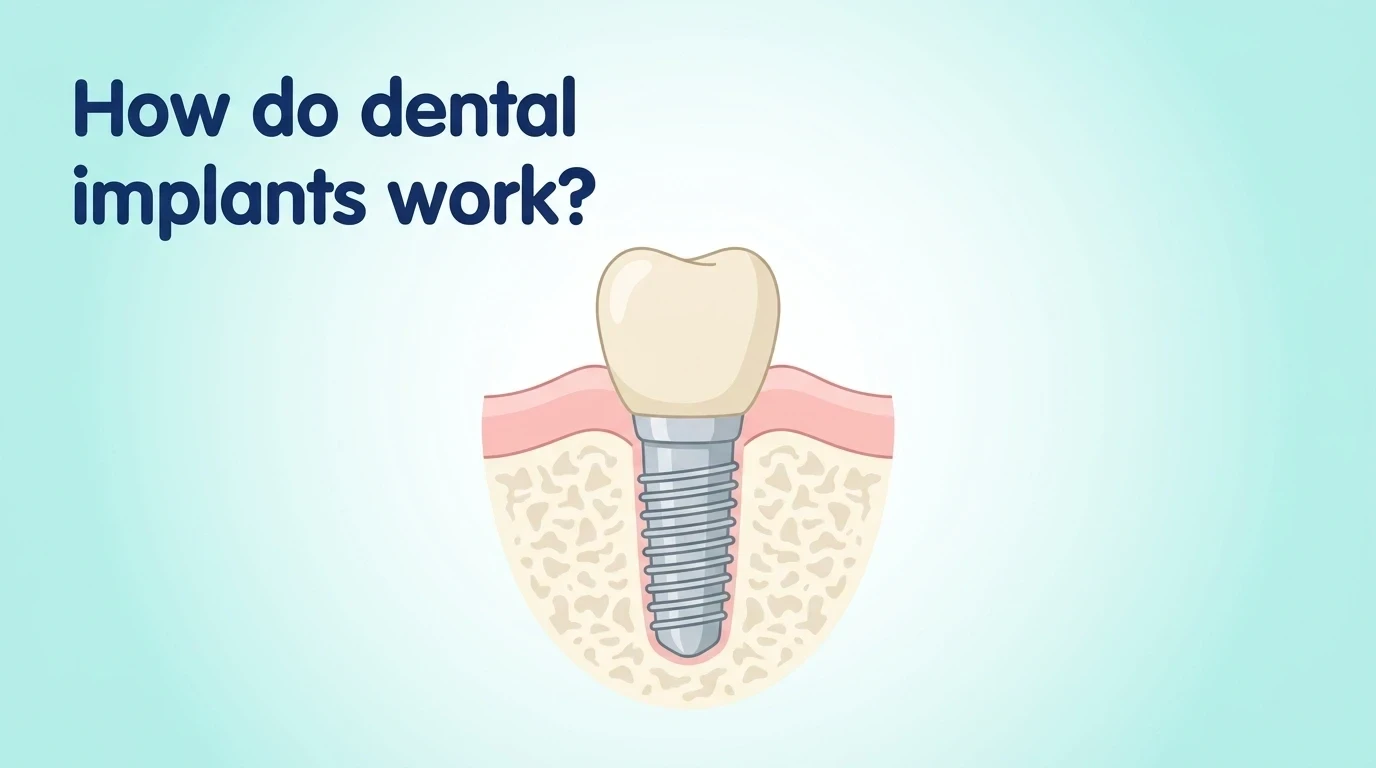
How do dental implants work? A titanium post is placed in the jawbone as an artificial root. The bone grows against the post over the following months, and a connector called an abutment then holds a crown, bridge or denture on top, so the replacement is anchored in bone.
What are the parts of a dental implant, and what does one look like?
A single-tooth implant has three parts: the post, the abutment and the crown. Only the crown is visible once treatment is finished.
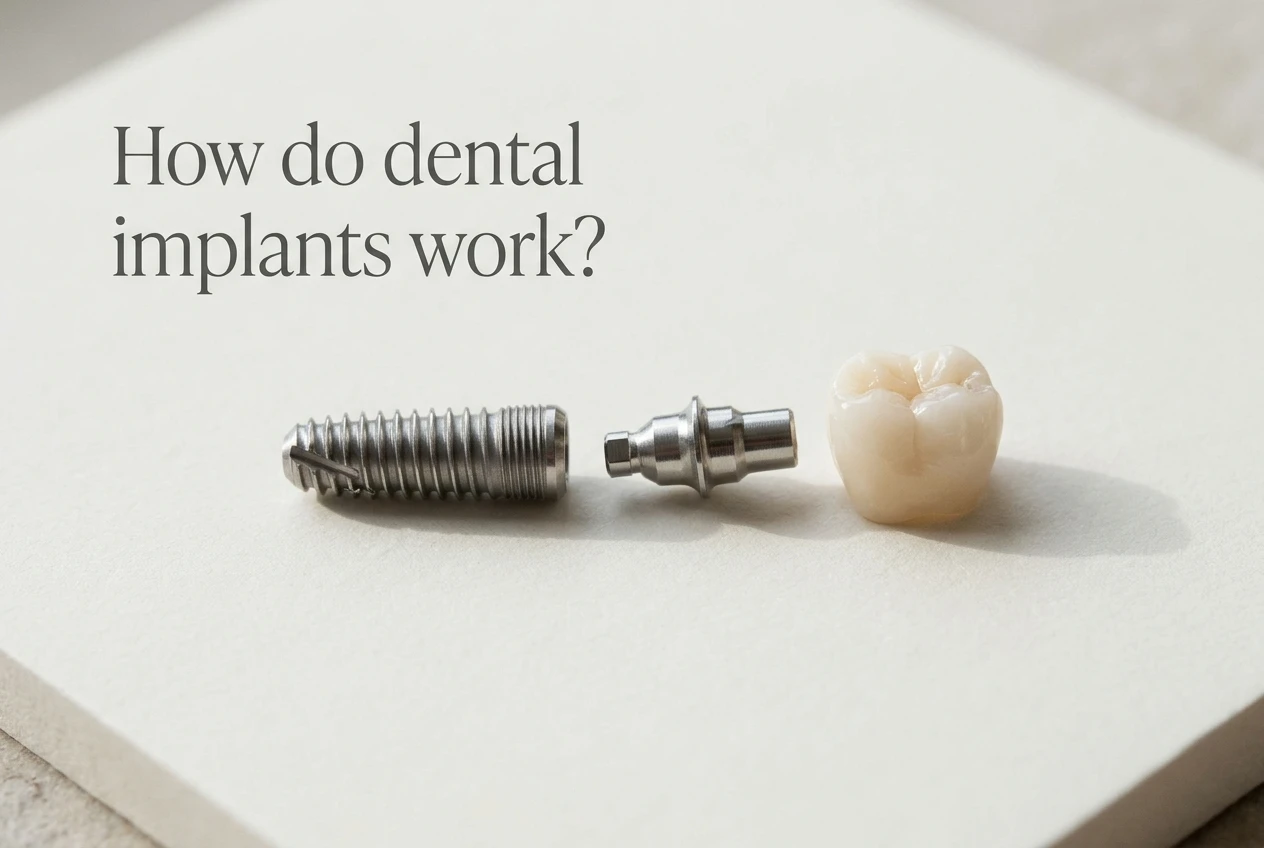
- The implant post. A small threaded screw, usually titanium, that sits in the jawbone where the tooth root was. It is the only part that goes into bone.
- The abutment. A connector that attaches to the top of the post and passes through the gum. It gives the crown something to fasten onto.
- The crown. The tooth-shaped part, usually made of porcelain or a ceramic material, matched to the shape and shade of your other teeth. It is either cemented onto the abutment or fixed with a small screw.
If you could see a finished implant out of the mouth, it would look like a short screw with a post on top and a tooth on the post. In the mouth you see a tooth emerging from the gum, much like any other.
How does a tooth implant work once it is in the jaw?
An implant works by fusing with the bone around it, so the crown on top is held as firmly as a natural root would hold it. This fusion is called osseointegration. Bone cells grow onto the surface of the titanium and lock the post in place.
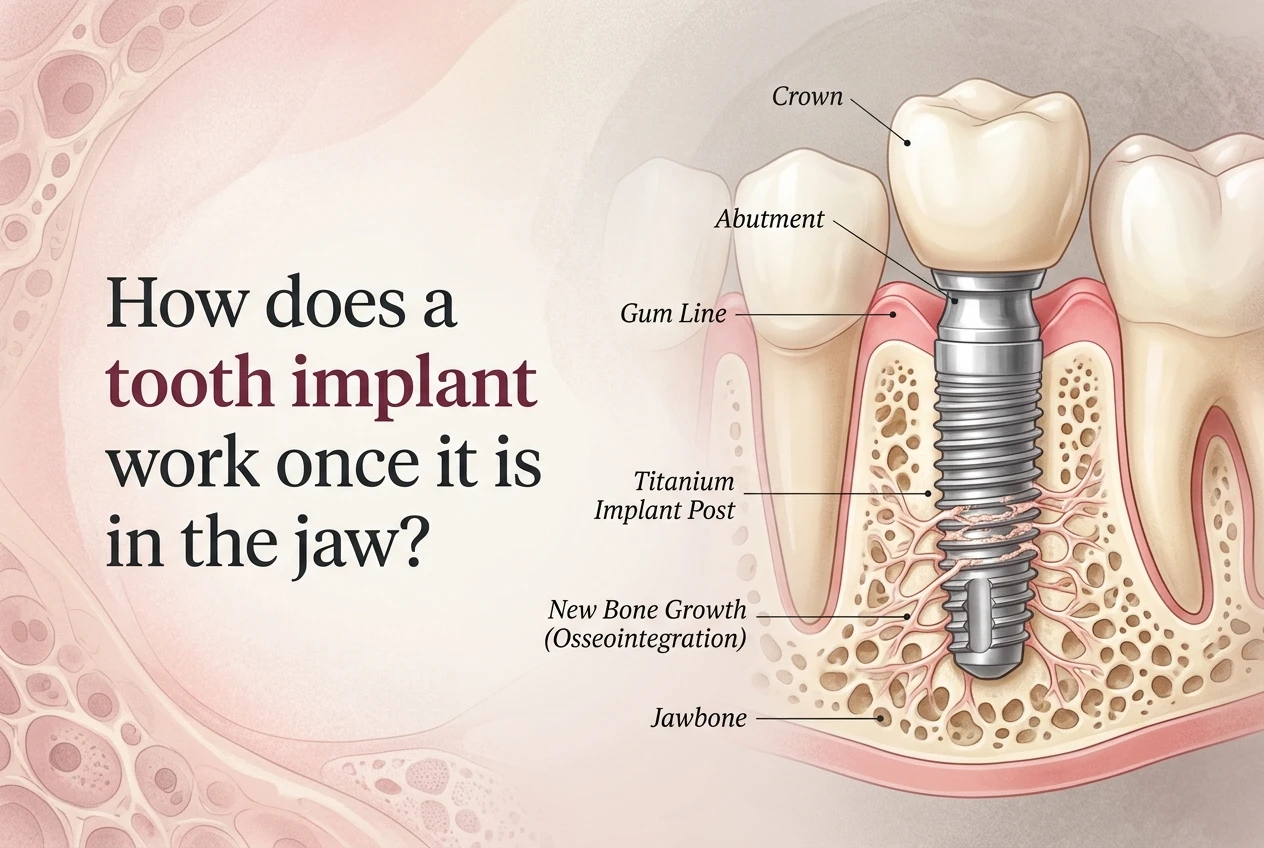
Chewing force travels from the crown through the abutment and post into the jaw. Because the post sits in bone, it carries that load directly, without resting on the gums or leaning on neighbouring teeth. Bone that carries load also tends to be kept in place, whereas bone under a missing tooth gradually shrinks.
The fusion takes time. Healing varies between people and depends on the bone and the site, so your dentist will give you a timeline for your own mouth rather than a general figure.
Why is titanium used in dental implants?
Titanium is used because bone will bond to it and the body generally tolerates it well. It is also strong enough to withstand years of chewing force at a small size, and it does not corrode in the wet environment of the mouth.
Some implants are made from ceramic (zirconia) instead, which suits people who want a metal-free option. The choice depends on the clinic and on your mouth, so it is a fair question to ask at a consultation: which material do they use, and why?
The key point is that the post is built to be accepted by bone. The crown can be made of whatever material gives the best appearance and bite.
How does dental implant surgery work, stage by stage?
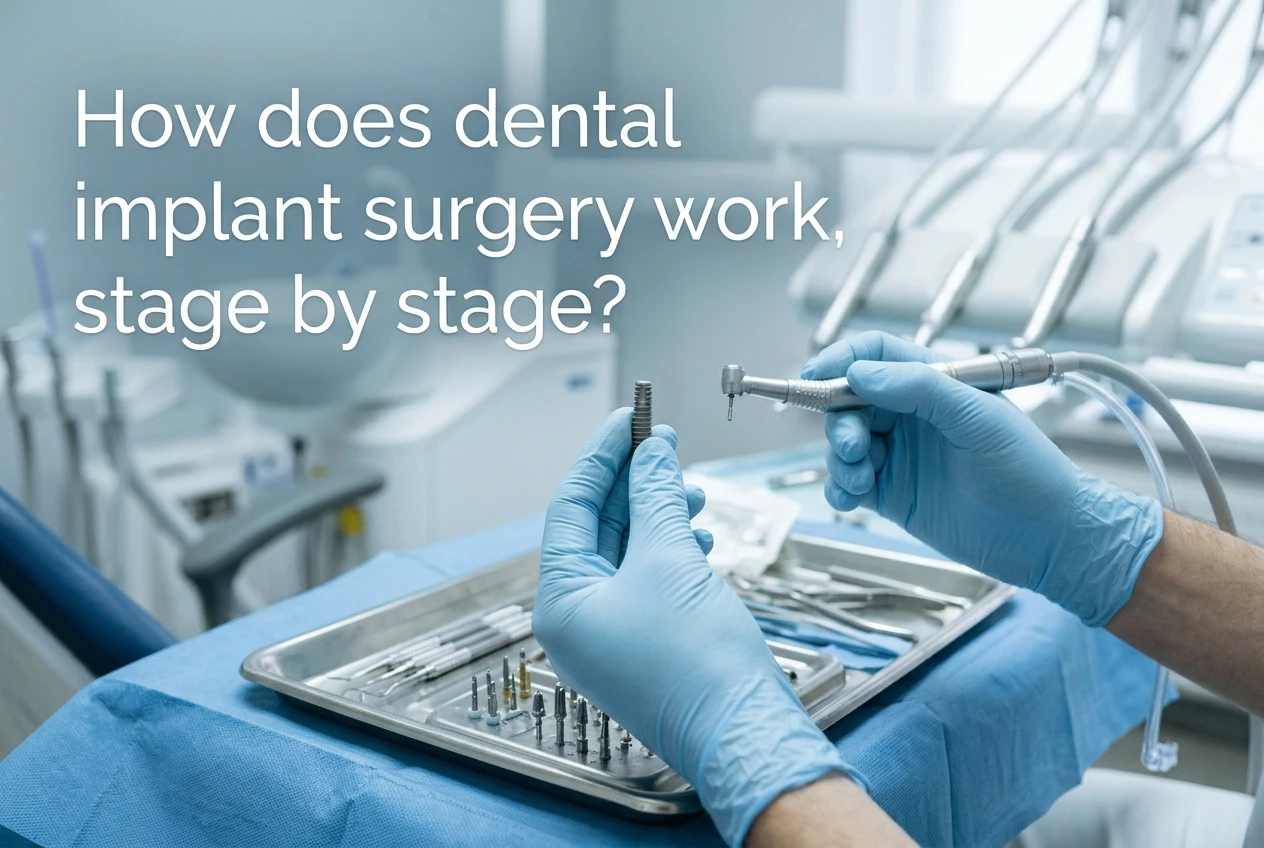
Implant treatment runs in stages over several months, and the surgery itself is usually done under local anaesthetic. Exact steps vary between clinics and cases, but the usual order is:
- Assessment and imaging. The dentist examines your mouth and takes X-rays or a 3D scan to check the quality and amount of bone and to plan where the post will go.
- Preparation, if needed. A failing tooth may need to be removed first. If the bone is thin, a bone graft can add volume before or during implant placement.
- Placing the post. The gum is opened, a small channel is prepared in the bone, and the titanium post is screwed in. The gum is then closed over it or fitted with a healing cap.
- Healing. Over the following 4 months or so the bone fuses with the post. You may be given a temporary tooth to wear in the meantime, depending on the site.
- Fitting the abutment. Once the post is stable, the abutment is attached. The gum around it needs a short period to settle.
- Fitting the crown. Impressions or a digital scan are used to make the final crown, which is then attached to the abutment.
Some clinics place the post and a temporary tooth on the same day when the bone allows it. Whether that is suitable depends on your assessment. The NHS overview of dental implants gives a general summary of the procedure and what to expect afterwards.
How do dental implants work with dentures?
Implants can hold a denture firmly in place, which stops it moving when you eat or speak. A conventional denture rests on the gums and relies on suction or adhesive. An implant-supported denture clips or screws onto a small number of posts in the jaw.
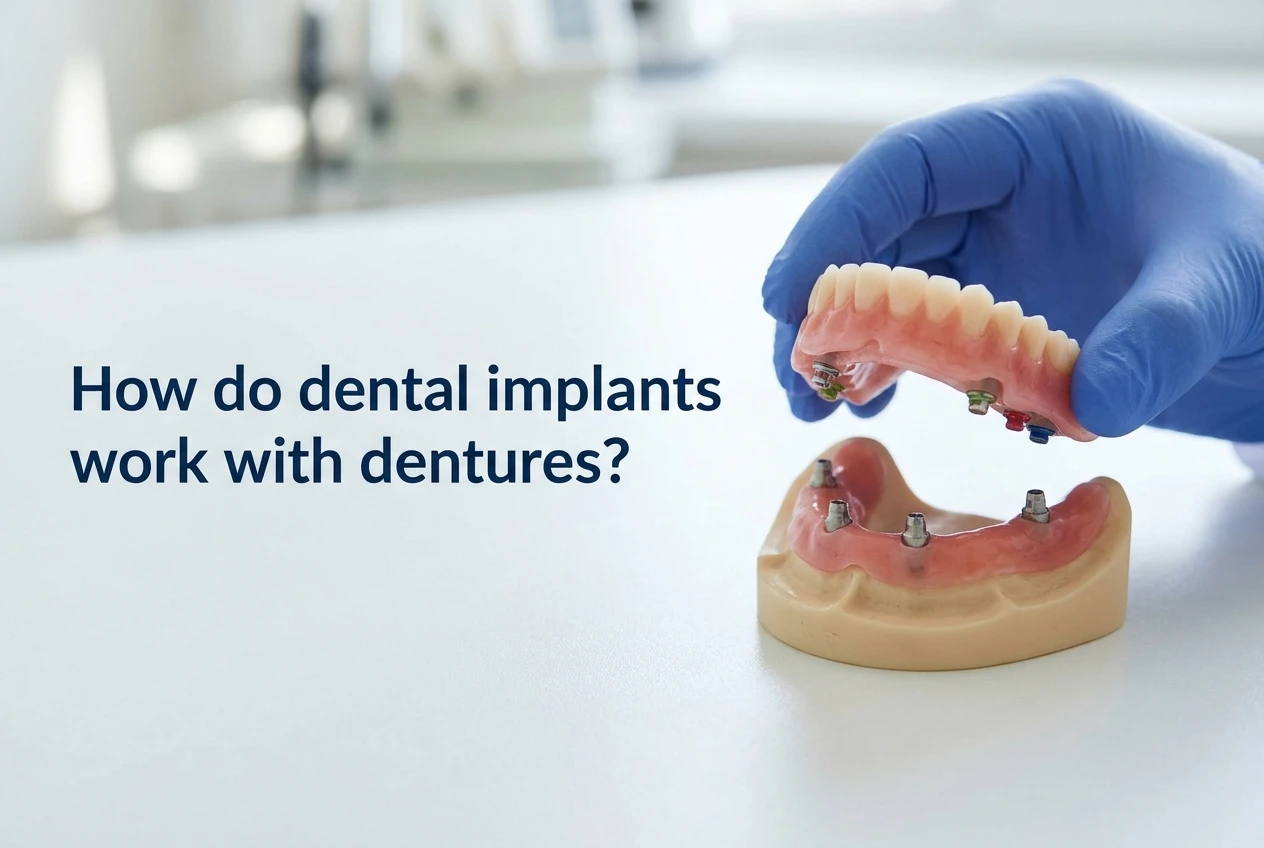
This is also how implants replace several or all teeth without needing one post per tooth. A few well-placed posts can carry a full arch of teeth.
Option | How it is held | Removable? |
|---|---|---|
Single implant crown | Own post in the bone | No |
Bridge | Crowns on the teeth either side of the gap | No |
Conventional denture | Rests on the gums | Yes |
Implant-supported denture | Clips or screws onto implants | Often yes, sometimes fixed |
A bridge is the main alternative to a single implant, because it needs the neighbouring teeth to be shaped to carry it. An implant stands on its own and leaves those teeth untouched. Your dentist can explain which option fits the gap you have.
How do dental implants feel compared with natural teeth?
Most people find a finished implant feels like a normal tooth when they bite and chew, because it is fixed in bone and does not shift. You can eat a normal range of foods once healing is complete and your dentist has cleared you.
There are small differences. An implant has no ligament around the root, as a natural tooth does, so the sense of pressure can feel slightly different. Some people notice this and some do not.
The first days after surgery usually involve some soreness, swelling and care with what you eat. Your dentist will give you instructions for that period and for pain relief. Persistent or worsening pain, or a post that feels loose, should be reported to the clinic.
Do dental implants need maintenance?
Yes. An implant cannot decay, but the gum and bone around it can still become inflamed or infected, and good cleaning is what prevents that. The condition is called peri-implantitis, and left untreated it can damage the bone holding the post.
Daily care is similar to natural teeth:
- Brush twice a day with a soft brush, including the gum line around the implant.
- Clean between the teeth every day with interdental brushes or floss, in the way your dentist or hygienist shows you.
- Attend check-ups and hygiene appointments as often as your dentist recommends, so they can check the gum, the bite and the fit of the crown.
- Avoid smoking, which raises the risk of implant problems.
The post is designed to last many years. The crown is the part more likely to need replacing over time, because it takes the daily wear of chewing. Ask what follow-up the clinic provides, since this matters most in the first year. The site’s piece on aftercare after treatment in Hungary explains how that works with follow-up in Wexford.
What should you settle before booking an implant consultation?
Before you book, know what you want to replace, what questions you will ask, and what you need to know about the full price. A little preparation makes the consultation more useful.
- Which teeth are involved. One tooth, several teeth or a full arch each call for a different plan.
- Your health and habits. Bring a list of medications and conditions, and be ready to say whether you smoke. These affect healing.
- The full treatment plan. Ask what is included: scans, any extraction or graft, the post, the abutment, the crown and follow-up visits. The site’s guide to the cost of implants goes through how to compare quotes.
- What the first visit involves. The consultation process piece sets out what usually happens, so you know what to expect.
- Who handles problems afterwards. Ask where you go if the gum is sore or the crown loosens, and who pays for it.
Write down your questions and take them with you. A clear plan, in writing, is a reasonable thing to ask for before you agree to anything.
Find out whether implants suit your mouth by reading Am I a Candidate for Dental Implants? Bone Loss, Grafts and What Happens If You’re Told No.
Why do dental implants need two trips to Hungary?
Implant treatment needs two trips to Perfect Smile Dental Implant Center in Hungary, because there is a gap of about 4 months in the middle while the implants fuse with the jawbone.

- Trip one: the implant posts are placed in the jaw. You then fly home while the bone grows onto the titanium.
- The gap: around 4 months of healing, during which osseointegration takes place.
- Trip two: once the posts have fused, the abutments and final crowns, bridge or denture are fitted.
This is the one part of treatment that cannot be rushed or shortened, which is why it is worth planning both trips before you book.
How does aftercare work for Irish patients at Hungarian Dentists Wexford?
Treatment at Perfect Smile Dental Implant Center in Hungary is more affordable than having the same work done in Ireland, and you are not left on your own afterwards. Aftercare is provided for patients in Ireland at the Hungarian Dentists Wexford Town Clinic, so check-ups and follow-up care can happen close to home between and after your trips.
A free consultation is available, so you can compare the cost of dental implants in Ireland with the cost at Perfect Smile before you commit to anything.
Call Fintan in Hungarian Dentists Wexford clinic on 087 349 0104.